
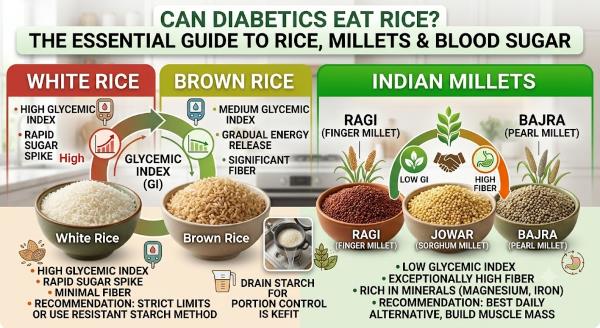
For millions of households across India, a warm plate of rice is more than just comfort food—it is a cultural staple. However, following a prediabetes or type 2 diabetes diagnosis, one of the most immediate and distressing questions patients ask is: “Can a diabetic eat rice?” or Can Diabetics Eat Rice?
The short answer is yes, but with essential caveats. You do not need to banish rice from your kitchen entirely. Instead, managing blood sugar levels effectively comes down to choosing the best rice for diabetes patients in India, mastering smart cooking techniques, practicing strict portion control, and integrating indigenous millet substitutes.
The Glycemic Index Breakdown: White Rice vs. Brown Rice vs. Millets
To understand how rice impacts blood sugar, we look at the Glycemic Index (GI)—a scale from 0 to 100 that measures how rapidly a carbohydrate food raises blood glucose after consumption.
- High GI (70+): Causes rapid glucose spikes and sharp insulin demand.
- Medium GI (56–69): Moderate digestion and steady release.
- Low GI (55 or lower): Slow digestion, gradual glucose release, and superior satiety.
Also Read: What Happens When You Avoid All Refined Carbs for 30 Days?
Grain Comparison Table
| Grain Variety | Processing Level | Average Glycemic Index (GI) | Fiber Content (per 100g) | Primary Impact on Blood Sugar |
|---|---|---|---|---|
| Polished White Rice (Sona Masoori/Ponni) | Highly Refined (Bran Removed) | 70 – 73 (High) | ~0.4g | Rapid post-meal glucose spike |
| Traditional Parboiled / Ukda Rice | Partially Steamed with Husk | 55 – 60 (Medium) | ~1.5g | Moderate absorption rate |
| Whole Grain Brown Rice | Outer Bran intact | 50 – 55 (Low to Medium) | ~3.5g | Gradual, steady energy release |
| Traditional Low GI White Varieties (e.g., Telangana Sona, Black Rice) | Unpolished / Specific Cultivar | 51 – 54 (Low) | ~2.0g | Sustained glycemic control |
| Millets (Foxtail, Jowar, Bajra, Ragi) | Whole Unrefined Grain | 45 – 55 (Low) | 6.0g – 10.0g | Excellent insulin sensitivity |
Can Diabetics Eat Rice? What is the Best Low GI Rice for Diabetes Patients in India?
If you prefer keeping traditional rice on your plate, switching from polished white rice to low GI rice varieties allows you to enjoy meals without triggering steep glucose spikes.
1. Parboiled / Single-Polished Rice (Ukda Chawal)
Widely consumed in Kerala, Karnataka, and Tamil Nadu, parboiled rice undergoes a hydrothermal process before milling. This forces essential nutrients from the outer husk into the grain kernel, altering its starch structure to make it digest more slowly.
2. Traditional Indian Heritage Varieties
Research by Indian agricultural institutes has highlighted several native rice varieties naturally rich in complex starches:
- Telangana Sona (RNR 15048): Developed specifically as a low GI white rice (GI ~51) offering the texture of standard rice with a gentler glucose impact.
- Kalanamak & Black Rice (Chak-Hao): Packed with fiber, resistant starch, and potent anthocyanin antioxidants that improve insulin sensitivity.
Also Read: Now Know The Role of Fiber in Maintaining a Healthy Gut
Cooking Techniques: Drained Rice vs. Pressure Cooked Starch
How you prepare your rice matters just as much as the grain you select.
❌ PRESSURE COOKING (Absorption Method)
   Water + Starch retained ➔ High gelatinization ➔ Fast digestion ➔ Glucose Spike

✔️ OPEN PAN BOILING (Draining Starch Water / Ganji)
   Excess water boiled ➔ Excess amylose strained off ➔ Slower digestion ➔ Stable Sugar
1. The Draining Method (Pasa Utarna)
Cooking rice in an open pot with excess water and straining off the liquid (ganji) removes a portion of readily accessible free starches. While this does not make white rice low-calorie, it moderately lowers the immediate glycemic impact compared to sticky, pressure-cooked rice.
2. The Cooling Effect: Creating “Resistant Starch”
A simple kitchen trick backed by nutritional science is retrogradation:
- Cook your rice (preferably brown, parboiled, or low GI white).
- Allow it to cool down completely and store it in the refrigerator for 8–12 hours.
- Reheat gently before eating.
Cooling alters the molecular structure of digestible starches, turning them into Resistant Starch (RS). Resistant starch acts like soluble fiber—it resists digestion in the small intestine, feeding healthy gut bacteria and reducing post-meal blood sugar spikes by up to 20–30%.
The Plate Method: Master Portion Control
You do not need to give up rice if you balance the rest of your meal correctly. Use the Diabetes Plate Method to naturally restrict your carbohydrate load:
- 25% of Plate: Rice portion (cooked, roughly 1 small bowl or ~100–120g).
- 25% of Plate: Protein source (Thick dal, sprouts, paneer, eggs, or lean chicken/fish).
- 50% of Plate: Fiber-rich, non-starchy green vegetables (Sabzi, Lauki, Bhindi, or fresh salad).
Pro-Tip: Always eat your salad/vegetables and protein first, saving the rice for last. Clinical studies show that consuming fiber and protein prior to carbohydrates delays gastric emptying and flattens postprandial glucose curves.
Indian Millet Substitutes: Superior Nutrition for Sugar Control
Swapping rice for traditional Indian millets 2 to 3 days a week provides rich dietary fiber, plant protein, and key minerals like magnesium and iron.
1. Foxtail Millet (Kangni / Navane) & Little Millet (Samai)
- Why it works: These small-seeded millets closely mimic the texture of rice when boiled.
- Best for: Replacing white rice directly in Pulao, Khichdi, or plain boiled rice dishes.
2. Jowar (Sorghum) & Bajra (Pearl Millet)
- Why it works: Exceptionally high in insoluble fiber and slow-digesting complex carbs.
- Best for: Making wholesome rotis or bhakris to pair with high-protein curries.
3. Ragi (Finger Millet)
- Why it works: Rich in calcium and polyphenols, though it has a slightly higher GI than Jowar or Bajra.
- Best for: Consumed as savory Ragi Mudde, fermented Dosa, or porridge rather than heavily sweetened dishes.
Also Read: Complete Information About Barnyard Millet: Nutrition, Health Benefits
Final Verdict
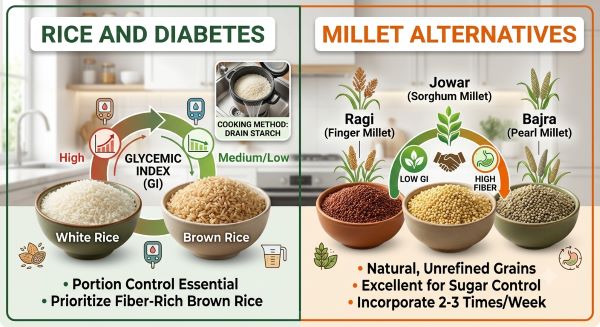
Can a diabetic eat rice? Absolutely.
To maintain healthy HbA1c levels while enjoying rice:
- Switch from refined white rice to brown rice, parboiled rice, or verified low GI varieties like Telangana Sona.
- Cook using the open-pan straining method or cool cooked rice overnight to build resistant starch.
- Control your portion size to $25\%$ of your total meal plate.
- Rotate your grain intake with nutritious indigenous millets like Foxtail, Jowar, and Bajra.
Disclaimer: This content on Can diabetics eat rice is for educational purposes only and should not replace clinical medical advice. Always consult your doctor or a certified dietitian to customize a meal plan suitable for your specific blood glucose readings.