
Cancer care in India is undergoing a monumental paradigm shift. For decades, a cancer diagnosis meant spending grueling hours hooked up to intravenous (IV) lines in crowded hospital wards. However, a revolutionary breakthrough has arrived on Indian shores: a 7-minute cancer immunotherapy injection.
This innovation, recently launched in India by Roche Pharma under the brand name Tecentriq—a formulation known as Atezolizumab subcutaneous (delivered with Halozyme’s Enhanze® technology)—is completely reshaping how oncologists manage advanced malignancies (Harris, 2024).
From the scientific mechanism to the financial realities in India, here is everything you wanted to know about this game-changing medical advancement
What Exactly is the 7-Minute Cancer Immunotherapy?
To understand this breakthrough, we must first look at standard immunotherapy.
Traditional immunotherapy uses checkpoint inhibitors—monoclonal antibodies that unmask cancer cells, allowing the patient’s own immune system to recognize and destroy them (Mao et al., 2020). Atezolizumab specifically targets the PD-L1 (Programmed Death-Ligand 1) protein found on tumor cells (Kicken et al., 2024). By blocking PD-L1, the drug reactivates T-cells to attack the tumor (Zaleskis et al., 2023).
Historically, delivering this medication required intravenous administration. Because large-molecule monoclonal antibodies are dense and difficult for the body to absorb through tissue, they had to be slowly trickled into the bloodstream via an IV drip. This process routinely took 30 to 60 minutes per session, excluding the hours required for IV setup, port access, and clinical monitoring (Kicken et al., 2024).
The Role of Hyaluronidase Technology
The “7-minute magic” is made possible by combining the immunotherapy drug with an enzyme called recombinant human hyaluronidase (Felip et al., 2021).
The subcutaneous tissue under our skin contains a natural barrier called hyaluronan, which restricts the absorption of large fluid volumes. Recombinant human hyaluronidase temporarily degrades this barrier locally (Felip et al., 2021). This allows a large dose of Atezolizumab to be injected right under the skin—usually in the thigh—and quickly absorbed into the vascular system. Within a few hours, the tissue barrier naturally restores itself.
Key Clinical Benefits: Why This Matters for Patients
This advancement is more than just a matter of convenience; it offers substantial clinical and logistical benefits backed by rigorous global trials.
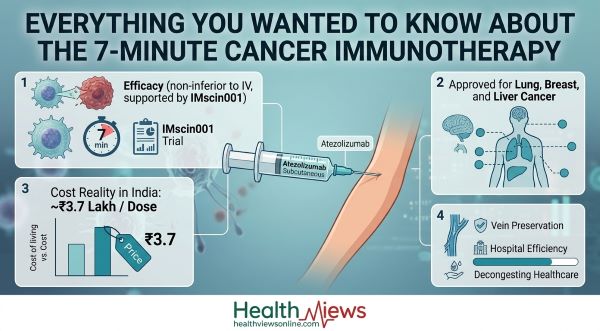
Equivalent Efficacy and Safety: The landmark IMscin001 Phase Ib/III clinical trial compared the subcutaneous injection directly to the traditional IV formulation (Harris, 2024). The trial conclusively demonstrated that the 7-minute injection provides non-inferior levels of the drug in the blood (pharmacokinetics) and achieves identical efficacy in treating cancers (Zaleskis et al., 2023). The safety profile remained consistent, with no new adverse side effects recorded compared to the standard IV route (Felip et al., 2021).
Drastic Reduction in Treatment Time: Instead of spending half a day at a daycare chemotherapy unit, the actual administration of the drug drops to approximately 7 minutes (Harris, 2024). This frees up hours of a patient’s life, minimizing the psychological burden of long hospital stays and exhaustion, particularly for elderly individuals (NDTV, 2026).
Preservation of Vein Health: Repeated IV infusions can cause peripheral veins to collapse or scar, often forcing patients to undergo surgical procedures for central venous access devices (like chemo ports). A subcutaneous injection completely bypasses the need for continuous venous access and reduces the risk of infusion-related infections or local tissue damage (Felip et al., 2021).
Which Cancers Can Be Treated by 7-Minute Cancer Immunotherapy?
The 7-minute subcutaneous immunotherapy injection is approved for the same indications as its intravenous predecessor (Harris, 2024). In India, this broadens treatment options across several aggressive malignancies, including:
- Non-Small Cell Lung Cancer (NSCLC): The most common form of lung cancer in India, where nearly half of patients may qualify based on cellular markers (Felip et al., 2021; NDTV, 2026).
- Small Cell Lung Cancer (SCLC): An aggressive form of lung cancer where rapid intervention is vital (Kicken et al., 2024).
- Triple-Negative Breast Cancer (TNBC): Providing a targeted option for one of the most complex sub-types of breast cancer.
- Hepatocellular Carcinoma (Liver Cancer): Offering systemic therapy options for advanced cases.
- Urothelial Carcinoma: Benefiting patients with advanced bladder cancers (Kicken et al., 2024).
Note: Eligibility depends heavily on a patient’s specific biomarker status (e.g., high PD-L1 expression levels), overall health, and staging. Always consult a certified oncologist to see if this treatment is appropriate.
The Reality Check: Financial Cost of 7-Minute Cancer Immunotherapy Injection in India
While the medical innovation is undeniable, the financial aspect poses a massive hurdle for Indian families. Advanced research, engineering, and technology make immunotherapy drugs notoriously expensive.
[Single Dose Cost]  ──► Approximately ₹3.7 Lakh
[Standard Course]  ──► ~6 Doses Needed
[Total Expense]    ──► Runs into several lakhs of rupees
For the average Indian household, paying ₹3.7 lakh per dose (with a full treatment course often requiring around six doses) represents a substantial economic burden (NDTV, 2026).
To help bridge this financial gap and increase patient accessibility, two primary relief avenues are currently available:
- Patient Assistance Programs: Roche Pharma operates a patient support initiative called the “Blue Tree” program, designed to provide financial and logistics guidance to eligible patients (NDTV, 2026).
- Government Schemes: Tecentriq has been included under the Central Government Health Scheme (CGHS), allowing eligible government employees and retirees to apply for reimbursement support (NDTV, 2026).
Also Read: Revolutionizing Cancer Treatment: Everhope’s Cancer Daycare Centre in Gurgaon
The Indian Healthcare Perspective: A Structural Relief
For a country like India, the introduction of a subcutaneous immunotherapy formulation offers massive healthcare advantages beyond the individual patient:
Decongesting Infrastructure: Major Indian oncology centers—like Tata Memorial Hospital or AIIMS—face a heavy burden of patients. Transitioning patients from IV chairs to a quick injection allows healthcare facilities to optimize bed capacity and treat significantly more individuals per day (NDTV, 2026).
Bridging the Rural-Urban Divide: Many Indian patients travel thousands of kilometers from tier-2 or tier-3 cities to major metros for cancer care. Reducing hospital time allows patients to receive their shots quickly and return home, lowering travel and lodging expenses.
The Verdict of 7-minute cancer immunotherapy Injection: A New Era of Patient-Centric Oncology
The 7-minute cancer immunotherapy represents a major leap forward in patient-centric oncology. By combining the survival benefits of modern checkpoint inhibitors with the unprecedented speed of a subcutaneous injection, it honors both the patient’s health and their time.
While financial access to advanced biological drugs remains an obstacle for many in India, the logistical relief this brings to hospitals and the physical relief it offers to patients marks a profound step forward in making cancer care more human-centric.
References
- Felip, E., Burotto, M., Zvirbule, Z., Herraez‐Baranda, L. A., Chanu, P., Kshirsagar, S., Maiya, V., Chan, P., Pozzi, E., Marchand, M., Monchalin, M., Tanaka, K., Tosti, N., Wang, B., & Restuccia, E. (2021). Results of a Dose‐Finding Phase 1b Study of Subcutaneous Atezolizumab in Patients With Locally Advanced or Metastatic Non–Small Cell Lung Cancer. Clinical Pharmacology in Drug Development, 10(10), 1142-1155. https://doi.org/10.1002/cpdd.936
- Harris, E. (2024). September 2024 therapeutic delivery: industry update. Therapeutic Delivery, 16(1), 1-8. https://doi.org/10.1080/20415990.2024.2442298
- Kicken, M. P., Deenen, M. J., Moes, D. J. A. R., Hendrikx, J. J. M. A., van den Borne, B. E. E. M., Dumoulin, D. W., van der Wekken, A. J., van den Heuvel, M. M., & ter Heine, R. (2024). An Evidence-Based Rationale for Dose De-escalation of Subcutaneous Atezolizumab. Targeted Oncology, 19, 779-787. https://doi.org/10.1007/s11523-024-01087-4
- Mao, C., Gorbet, M.-J., Singh, A., Ranjan, A., & Fiering, S. (2020). In situ vaccination with nanoparticles for cancer immunotherapy: understanding the immunology. International Journal of Hyperthermia, 37(3), 4-17. https://doi.org/10.1080/02656736.2020.1810333
- NDTV Health. (2026, May 17). 7-Minute Cancer Shot Costing Rs 3.7 Lakh Per Dose Launched In India. NDTV. https://www.ndtv.com/health/7-minute-cancer-shot-costing-rs-3-7-lakh-per-dose-launched-in-india-11507285
- Zaleskis, G., Talaikis, M., Characiejus, D., Urbonas, V., Bosas, P., Darinskas, A., Zibutyte, L., Simkus, L., Survila, Z., Jursenaite, J., & Zvirble, M. (2023). Atezolizumab Retains Cellular Binding to Programmed Death Ligand 1 Following Aerosolization via Mesh Nebulizer. Anticancer Research, 43(3), 1065-1072. https://doi.org/10.21873/anticanres.16251
Disclaimer: This article is for informational purposes only and does not substitute professional medical advice, diagnosis, or treatment. Always seek the advice of your oncologist or other qualified healthcare provider with any questions you may have regarding a medical condition.