
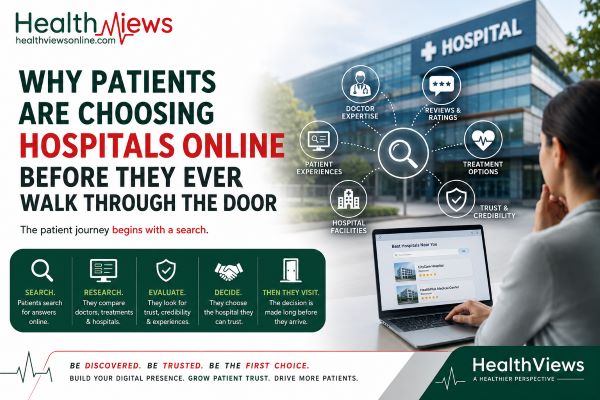
Why Patients Are Choosing Hospitals Online – For hospitals, the patient journey no longer begins at the reception desk. It begins with a search.
A husband has chest pain. The wife immediately looks for a cardiologist near me. Someone has just received a cancer diagnosis and they start searching for the best oncologist. Another person needs a knee replacement and wants to know which hospital has the right specialist.
Before calling the hospital, many patients — and increasingly their families — are doing something else:
They are going online. Yes, patients are choosing hospitals online
They search the hospital name. They look at its website. They check doctors, specialities, reviews, treatment options, infrastructure, patient experiences and even social media presence.
And within minutes, they may have already formed an opinion.
This is changing healthcare marketing in a fundamental way.
For hospitals, digital visibility is no longer simply about getting noticed. It is about becoming trusted before the patient ever walks through the door.
Patients Are Choosing Hospitals Online: The First Investigation May Happen on Google
Healthcare is deeply personal. Patients are not buying an ordinary product. They are choosing someone to trust with their health, their family and sometimes their life.
That is why patients rarely make hospital decisions based on a single advertisement.
They investigate.
A hospital may have state-of-the-art infrastructure, highly experienced specialists and advanced technology. But if a patient cannot easily find credible information about these strengths online, they may never know they exist.
The digital experience has therefore become an extension of the hospital experience.
A patient may ask:
- Does this hospital treat my condition?
- Who are the specialists?
- What technology or treatment options are available?
- Does the hospital have experience with complex cases?
- What do other patients say?
- Is the information on the website credible?
- Does the hospital appear transparent and professional?
- Can I understand what happens during treatment?
The hospital that answers these questions clearly has an advantage.
Patients Are Looking for Proof, Not Just Promotion
Traditional hospital advertising often focuses on statements such as:
- “World-class infrastructure.”
- “Advanced technology.”
- “Expert doctors.”
- “Comprehensive healthcare.”
But today’s digital patient wants more than claims.
They want evidence.
That evidence can come through expert articles, doctor interviews, patient education content, treatment explainers, hospital stories, research contributions, accreditation information, clinical expertise and meaningful thought leadership.
For example, instead of simply saying that a hospital has an advanced cancer-care programme, the hospital can demonstrate its expertise through an article explaining:
“When Should a Patient Consider Immunotherapy?”
A cardiac centre can publish:
“5 Warning Signs of Heart Disease That Should Never Be Ignored.”
A robotic surgery centre can explain:
“Who Is a Good Candidate for Robotic Surgery?”
This kind of content does something an advertisement cannot easily do.
It demonstrates expertise.
Your Doctors Are Part of Your Hospital’s Digital Reputation
There is another important shift taking place.
Patients are not only searching for hospitals.
They are searching for doctors.
A patient may search:
- “Best neurologist near me.”
- “Experienced oncologist for breast cancer.”
- “Cardiologist for heart failure.”
- “Best spine surgeon in Mumbai.”
This means a hospital’s digital authority is closely connected to the visibility and credibility of its doctors.
A hospital can therefore benefit when its specialists regularly contribute expert opinions, publish educational content, participate in interviews and become visible voices within their respective fields.
The objective isn’t to turn every doctor into an influencer.
It is to make their professional expertise discoverable.
Because when patients can see the people behind the hospital’s clinical expertise, the institution becomes more human and more trustworthy.
Also Read: Best Oncologists in Navi Mumbai: A List of Top Cancer Specialists
Reviews Matter — But Reputation Is Bigger Than Reviews
Online reviews are important, but a hospital’s digital reputation is much broader than its star rating.
Patients can encounter your hospital through:
- Google search
- Hospital websites
- Doctor profiles
- Health portals
- News articles
- Interviews
- Social media
- YouTube
- Patient testimonials
- Educational articles
- Media coverage
Every one of these touchpoints contributes to the perception of the institution.
A hospital therefore needs to ask:
“If a potential patient searches our name today, what story does the internet tell about us?”
That is a powerful question for hospital leadership.
Patients Are Choosing Hospitals Online: The Website Is No Longer Just a Digital Brochure
Many hospital websites still function primarily as information repositories.
- Departments.
- Doctors.
- Contact numbers.
- Facilities.
But a modern healthcare website should do more.
It should help a patient make a decision.
That means information should be easy to understand, medically responsible and designed around actual patient questions.
Instead of simply listing:
“Orthopaedics Department”
the hospital can create useful resources around:
- Knee replacement
- Arthritis
- Sports injuries
- Joint pain
- Robotic orthopaedic surgery
- Recovery after surgery
- When surgery may be recommended
This creates multiple opportunities for the hospital to be discovered when patients are searching for answers.
Search visibility begins with being useful.
Also Read: Robotic Surgery in India: Know Why the Country Is the Global Capital in 2026
Content Can Become a Patient Acquisition Asset
For hospitals, healthcare content should not be treated as something that is published simply to “keep social media active.”
Good content can work much harder.
- An expert article can establish authority.
- A doctor interview can introduce expertise.
- A treatment explainer can answer a patient’s question.
- A patient story can create emotional connection.
- A video can simplify complex medical information.
- A media feature can strengthen credibility.
- A LinkedIn thought-leadership post can put hospital leadership in front of industry stakeholders.
Together, these create a digital ecosystem around the hospital.
And unlike a traditional advertisement that disappears when the campaign ends, a well-created article or interview can continue attracting attention long after publication.
The Patient Journey Is Becoming a Research Journey
Imagine two hospitals offering a similar procedure.
Hospital A has excellent infrastructure but limited online information.
Hospital B has a strong website, visible specialists, educational articles, interviews, treatment information and a consistent digital presence.
Which hospital feels more familiar to the patient?
Often, it is Hospital B.
Not necessarily because it provides better clinical care.
But because the patient has already encountered its expertise online.
That familiarity can influence confidence.
And in healthcare, confidence matters.
Patients Are Choosing Hospitals Online: What Should Hospitals Do Now?
Hospitals do not necessarily need to become aggressive marketers.
They need to become better communicators of their existing expertise.
A practical digital authority strategy can include:
1. Make specialists discoverable
Build strong, accurate profiles for doctors and clinical leaders.
2. Answer real patient questions
Create educational content around the conditions and treatments patients are actually searching for.
3. Showcase expertise
Highlight specialists, technologies, departments, achievements, research, innovations and clinical capabilities.
4. Build third-party credibility
Media features, expert interviews and credible external publications can strengthen trust beyond the hospital’s own website.
5. Make leadership visible
Hospital directors, CEOs and medical leaders can contribute thoughtful perspectives on healthcare trends, innovation and patient care.
6. Keep information consistent
Your website, social media, doctor profiles and external media presence should tell a consistent story.
The New Hospital Marketing Question
The question is no longer simply:
“How much are we spending on advertising?”
Hospital leaders should also be asking:
- “What happens when a patient searches for us?”
- Do they find expertise?
- Do they find credible doctors?
- Do they find useful information?
- Do they find evidence of your capabilities?
- Do they understand what makes your hospital different?
And most importantly:
Do they feel confident enough to take the next step?
Because the patient may already be making a decision before they ever call your hospital.
The Future Belongs to Hospitals That Are Discoverable, Credible and Human
Healthcare will always depend on clinical excellence.
But clinical excellence that remains invisible online may not receive the attention it deserves.
The hospitals that stand out in the coming years will not simply be the ones with advanced infrastructure.
They will be the ones that can communicate their expertise clearly, consistently and credibly across the digital patient journey.
Because today’s patient may meet your hospital online first.
Make that first impression count.
Published by HealthViews — A Healthier Perspective