

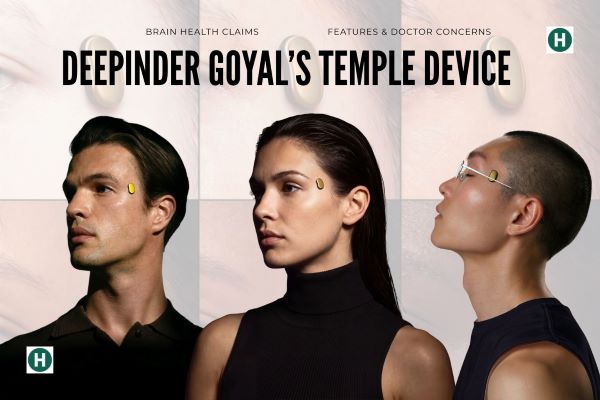
Deepinder Goyal’s Temple Wearable Device: Breakthrough in Brain Health or Technology Ahead of the Evidence: A small device attached to the side of the forehead has become the centre of a much larger debate about technology, healthcare and the limits of what consumers should expect from wearable devices.
Called Temple, the new wearable developed by Zomato founder Deepinder Goyal is priced at ₹85,000 in India and is designed to continuously capture physiological signals using optical sensors positioned near the temple. The product has attracted significant public attention, including interest from celebrities and athletes, but has also triggered questions from doctors and health experts about whether its measurements can genuinely be interpreted as information about blood flow inside the brain.
Goyal has maintained that Temple is a fitness and AI product, not a medical device, and has repeatedly said that it is not intended to diagnose or prevent disease. That distinction is at the heart of the controversy.
What is Deepinder Goyal’s Temple?
Temple is a head-worn wearable that uses optical sensing technology to monitor physiological changes around the temple. Its two prominent metrics are BrainFlow and Entropy.
BrainFlow is intended to track relative changes associated with cerebral circulation, while Entropy is presented as a broader physiological metric that can respond to factors such as exercise, sleep, stress, food, caffeine and meditation. Reports describe Entropy as a real-time score intended to indicate how hard the body is working to maintain physiological balance.
The concept is unusual because most consumer wearables measure signals from the wrist, finger or chest. Temple attempts to obtain information from the head itself.
The company has also linked its research to Goyal’s Gravity Ageing Hypothesis, which explores whether the effects of gravity and circulation over a person’s lifetime could play a role in ageing. However, this remains a research hypothesis rather than an established explanation of human ageing.
Can a wearable device on the forehead actually measure blood flow in the brain?
This is the most important scientific question surrounding Temple.
The technology uses optical sensing, broadly related to photoplethysmography (PPG). Such sensors shine light into tissue and analyse changes in the returned signal associated with blood-volume changes.
The challenge is that a sensor placed against the skin does not automatically have a direct view of blood circulating inside the brain.
The temple contains superficial blood vessels, and optical signals can be influenced by blood flow in tissues outside the skull. Several neurologists have therefore questioned whether a signal detected at the surface can reliably represent cerebral blood flow.
Dr Vinit Suri, senior neurologist and researcher at Indraprastha Apollo Hospitals, has argued that circulation detected around the temple should not automatically be treated as circulation within the brain. Dr Neeraj Jain, professor and head of neurology at KEM Hospital, Mumbai, has similarly emphasised the difficulty of distinguishing cerebral circulation from superficial scalp circulation using optical sensors.
Dr Girish Nair of Apollo Hospitals, Navi Mumbai, has also stressed that a light sensor on the temple is not directly looking inside the brain.
That does not necessarily mean the technology is useless. It means that the scientific interpretation of the signal requires validation.
What does Zomato Temple’s research show?
Temple’s developers have presented preliminary research comparing its BrainFlow measurements with transcranial Doppler (TCD), an established technique used to measure blood-flow velocity in major arteries inside the skull.
One study involved 23 healthy adults and examined changes during exercise and changes in body position. According to information shared by Goyal, Temple’s BrainFlow showed a correlation of approximately 0.8 with middle cerebral artery blood-flow velocity in the study.
This is potentially interesting.
However, correlation does not necessarily mean that two technologies are measuring exactly the same physiological quantity. TCD measures blood-flow velocity in specific intracranial arteries, whereas Temple produces a proprietary index derived from optical signals.
The research is also early-stage. Reports have noted that the studies supporting Temple’s claims have been company-funded preprints and have not yet been independently replicated or established through extensive clinical validation.
This is where independent research becomes important.
A promising result in a small group of healthy volunteers can justify further investigation. It does not, by itself, establish that a device is accurate across elderly people, patients with neurological diseases, people with vascular conditions or users in ordinary real-world environments.
What are doctors worried about wearable device temple?
The medical community’s criticism is not necessarily an argument against wearable technology itself.
The central concern is clinical meaning.
Suppose Temple reports that a person’s BrainFlow value has decreased. What does that actually mean?
- Does the person need a medical examination?
- Does it indicate a risk of stroke?
- Does it predict dementia?
- Should medication be changed?
- Should the person undergo an MRI or Doppler test?
At present, there are no established clinical guidelines that allow a consumer to answer these questions simply from a Temple reading.
Dr Seema Shahi, Director and Head of Neurology at Pacific One Health Hospitals, Delhi, has noted that brain health involves far more than blood circulation, including neuronal activity, electrical signalling, cognition, memory and communication between nerve cells. She said early research around Temple is interesting but insufficient to establish it as a validated clinical diagnostic tool.
Dr Abhijeet Gaikwad of Inamdar Multispecialty Hospital, Pune, has similarly cautioned that readings affected by sensor placement, movement, physical activity and individual circulation should not automatically be interpreted as direct measurements of cerebral circulation.
This distinction is critical: measuring a physiological signal is not the same as proving that the signal can diagnose a disease.
Temple is not a replacement for established medical tests
Doctors already have several established tools for investigating cerebral circulation when clinically required. These include transcranial Doppler, CT angiography, MR angiography and CT/MRI perfusion studies.
These tests are designed for specific clinical questions and are interpreted in the context of symptoms, medical history and other investigations.
Temple’s developers have not claimed that the wearable replaces these tests. In fact, Goyal has explicitly stated that Temple is not proven to diagnose or prevent disease and should not replace medical consultation.
That clarification is important because consumer enthusiasm can sometimes go beyond what the technology itself claims.
Also Read: Digital Health Ecosystems: How Tech Giants Are Shaping the Future of Medicine
The regulatory question around Temple, the Wearable Device
Another major issue is where the boundary lies between a wellness wearable and a medical device.
If Temple is marketed strictly as a fitness and wellness product, its regulatory position can be different from that of a device making explicit diagnostic or treatment claims.
Goyal has said that Temple is a fitness-and-AI product and that the company will obtain regulatory clearances wherever they are required before making claims that require them.
That approach puts the responsibility partly on the company to ensure that marketing language does not cause consumers to interpret a wellness metric as a clinically established diagnosis.
Why the ₹85,000 price matters
At ₹85,000, Temple is not an impulse purchase for most Indian consumers.
The price makes the question of demonstrable value particularly important.
For a consumer, the issue is not simply whether the technology is impressive. It is whether the information generated provides a meaningful benefit that justifies the cost.
This is where Temple faces perhaps its biggest commercial test.
A smartwatch can measure several familiar parameters and has become a daily-use device for many consumers. Temple is asking consumers to pay a substantial premium for a relatively new category of physiological monitoring.
Goyal has defended the price, saying that the product reflects the work and investment behind its development, while also telling consumers that they can wait for user reviews before deciding whether it is worth buying.
Deepinder Goyal’s Temple Wearable Device: Innovation versus evidence
The strongest argument in favour of Temple is that new technologies cannot mature without experimentation.
Wearable technology has already transformed the way people monitor exercise, heart rate, sleep and recovery. Developing a device capable of continuously studying physiological changes around the head could eventually generate valuable research data.
The strongest argument against premature enthusiasm is that healthcare is different from consumer electronics.
A smartphone can have an imperfect feature. A health metric can influence behaviour, anxiety and medical decisions.
That is why independent validation matters.
Critics have therefore called for larger studies, independent researchers, different age groups, different health conditions and long-term follow-up before Temple’s measurements are given broader clinical significance.
The bigger lesson for India’s health-tech industry
The Temple controversy is bigger than Deepinder Goyal or one ₹85,000 device.
It raises an important question for India’s rapidly growing health-tech ecosystem:
Also Read: How AI Is Changing Preventive Heart Health | AI in Cardiology
When does a wellness metric become a medical claim?
India needs ambitious entrepreneurs willing to experiment with advanced technologies. At the same time, healthcare innovation requires a higher standard of evidence because consumers may interpret technology as medical authority.
Temple could eventually prove to be an important step in wearable physiology. It could also turn out that some of its current measurements have limited practical value.
It is simply too early to know.
For now, the most reasonable position is neither to dismiss Temple as a gimmick nor to accept every suggested implication as established science.
The technology deserves testing, not blind faith.
Consumers should also remember that established approaches to protecting brain health remain far less glamorous but far better supported: regular physical activity, adequate sleep, a balanced diet, avoiding smoking, and controlling blood pressure, diabetes and other cardiovascular risk factors.
Temple may eventually tell us something useful about the human body.
But until larger and independent research establishes what its numbers actually mean, a number on a wearable should remain information to investigate—not a diagnosis to believe.
The Science and Research behind Temple Device – here