

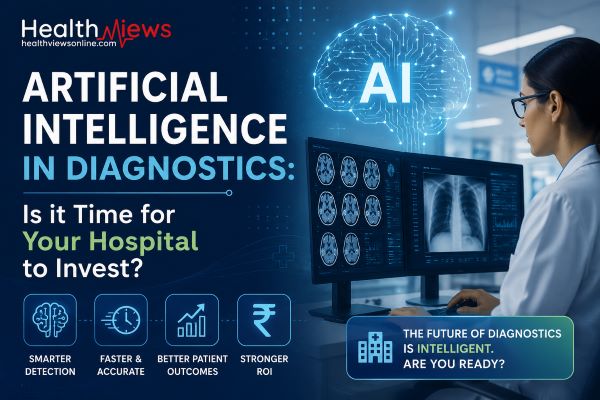
AI in diagnostics for medical imaging and laboratory tests has gone from science fiction to science fact. Now, the critical question facing all hospital administrators, board members, and medical staff is whether or not now is the time to invest in artificial intelligence to improve diagnostic services within the hospital.
The decision to invest in artificial intelligence for medical imaging or laboratory analyses has gone from being a futuristic idea to a current debate among all medical administrators. Artificial intelligence in these areas of medicine is a growing market that is regulated by the FDA and other international regulatory bodies. While the initial investment into implementing ai in medical diagnostic services is significant, the complexities of the implementation of such technology are daunting for most hospitals.
Artificial Intelligence in Hospital Diagnostics: A Pragmatic Guide to AI Adoption
The article explores the use of artificial intelligence in hospital diagnostics with an eye towards providing hospital leaders with information that will allow them to make sound decisions regarding whether or not to adopt AI in their diagnostic departments.
The Value Proposition: Why AI in Diagnostics Matters
In order to understand in what ways a hospital may benefit from the adoption of artificial intelligence within its diagnostic departments, it is first important to understand the value that artificial intelligence in diagnostics provides to hospitals. AI is not designed as a means of replacing specialists within hospital settings, but instead as a tool that can aid these specialists in their daily work.
Enhanced Clinical Decision Support
One of the main values of diagnostic AI algorithms is its ability to act as a second set of eyes for diagnostic specialists. For example, AI applications can be utilized to review medical imaging studies such as CT scans or mammograms, and to alert hospital staff of any abnormalities within those scans. This ability to detect abnormalities can lead to the earlier diagnosis of critical medical conditions.
Operational Efficiency and Triage
Fatigue contributes to diagnostic errors. One of the highest priorities for AI in medical diagnostics would be automated triage of medical imaging. AI systems can analyze medical images instantly as they are acquired by the patient. Urgent cases can be automatically prioritized within the work list for the radiologist or cardiologist.
Workflow Streamlining and Productivity
Medical imaging AI can automate various tasks that are typically performed by technicians and physicians. For instance, echocardiograms can have their hearts automatically segmented by an AI system, allowing physicians to focus on the analyses rather than the measurements of the heart chambers.
Evaluating the Clinical Intelligence: Assessing the AI Market
The market for diagnostic artificial intelligence algorithms is exploding. Thousands of different algorithms have been published, with hundreds receiving FDA clearance for various medical applications. The market for these AI systems is segmented according to the medical area in which they are applied. AI in medical imaging (both radiology and cardiology) is the most mature area of AI in medicine so far. Medical imaging AI systems can be applied to a variety of functions within medicine:
Computer-Aided Detection (CADe) systems can alert physicians to potential areas of interest on medical images (areas of increased density on mammograms or X-ray images, for example).
Computer-Aided Diagnosis (CADx) systems attempt to provide a diagnosis to the detected lesion in the medical image.
Quantitative Imaging Artificial Intelligence systems can measure various medical parameters, such as the amount of calcium in the coronary arteries, the ejection fraction of the heart, or the volumes of various organs in the body.
AI in Laboratory Diagnostics and Pathology
Artificial intelligence in the field of pathology (also known as digital pathology) is rapidly advancing. Digital pathology applications mainly focus on the analysis of large images of slides from tumor samples to detect and classify tumors and identify biomarkers (such as detecting HER2-positive cells in breast cancer tissue samples).
Financial Sustainability: The ROI and Costs of Investment
The decision to invest in an AI technology for a hospital requires a thorough cost-benefit analysis to determine if the technology is financially sustainable. The hospital will have to weigh the high initial capital expenditure against the gains that can be made through the implementation of the AI technology.
The Costs of AI Adoption
There are several costs associated with the adoption of AI technologies in hospitals. These costs include the purchase of the software, the data and computing infrastructure needs of the software, the integration of the software with existing hospital systems, and the training of hospital staff to operate the software.
The Return on Investment (ROI)
The ROI for AI in the hospital setting is also difficult to quantify. Specifically, there is no direct ROI for the purchase of AI software from reimbursing patients for the software. However, there are some indirect financial benefits of using AI software:
- Increased workload capacity for clinicians
- Reduced turnaround times (TAT) for critical patients
- Enhanced reputation of the hospital as a leader in medical technology that will compete with other notable hospitals for patients and clinical staff
Also Read: From Diagnosis to Cure: How AI-Driven Drug Discovery Is Speeding Up Treatment Development
Key Implementation Barriers: Moving Beyond the Pilot Project
Despite the immense potential of artificial intelligence in medical diagnosis, few hospitals are currently running AI seamlessly across their hospitals. To roll out the protocols seen in the pilot project across the hospital, several barriers will have to be overcome:
- Integration with outpatient workflow – most diagnostic tools focus on the inpatient hospital workflow. However, adapting these tools to the outpatient workflow’s high volume and diverse patient populations is challenging.
- Data privacy and security (HIPAA compliance) – as with any cloud-based solution, data security and HIPAA compliance will be essential requirements for hospitals considering the implementation of artificial intelligence in their medical diagnosis protocols.
- Physician adherence – as with any new technology, physicians will be skeptical. To gain the physicians’ support for the algorithm, it will be necessary to demonstrate the algorithm’s validity, explainability, and ease of use in the outpatient clinics.
- Regulatory issues regarding FDA clearance – the FDA has given clearance to hundreds of artificial intelligence algorithms that cannot learn from outcomes after they are released into the environment. However, there is no established protocol for self-learning algorithms that will adapt after they are released into the hospital environment.
Is it Time? A 90-Day Action Plan for ROI and Adoption
The question is not whether hospitals should adopt artificial intelligence in their diagnostic services but when and where to begin. It is not a question of whether hospitals should implement AI into their diagnostic processes but at what pace and in what areas they should begin to roll them out. Hospital administrators should not rush into implementing an artificial intelligence system that has yet to be proven effective in diagnostic medicine. Instead, they should begin with incorporating AI into one targeted diagnostic service.
Here are nine steps that hospital administrators can take over a 90-day period to begin to implement AI into their diagnostic services:
Days 1–30: Identify the High-Impact Use Case
Don’t choose AI to solve a general problem; choose it to fix a specific operational bottleneck. Gather clinical and operational leadership to identify one targeted diagnostic service line with:
- High case volume.
- A fatigue-driven or error-prone task (e.g., detecting subtle fractures or prioritizing critical chest CTs).
- Clear clinical champions who are enthusiastic about the technology.
Also Read: Smart Hospitals of the Future: Integrating AI, IoT, and Robotics
Days 31–60: Evaluate Evidence and Infrastructure
Analyze the marketplace for your chosen use case. Request independent clinical evidence from vendors, not just their marketing materials. Critically evaluate your hospital’s existing IT infrastructure to understand the CapEx needed for local or cloud implementation.
Days 61–90: Develop the Business Case and Pilot Protocol
With the use case, evidence, and infrastructure needs identified, build the business case. Define clear success metrics (e.g., decrease in critical case triage time, reduction in missed nodule counts). Finalize the operational workflow for a 90-to-180 day pilot project with one vendor.
Conclusion
Artificial intelligence in diagnostics is not the passing trend of today but the new standard of care for hospitals. For those facilities that rely heavily on diagnostic medical images and laboratory tests, the utility of artificial intelligence is simply too great to ignore.
Is it time for your hospital to invest in artificial intelligence in diagnostics? It depends on your hospital’s readiness to overcome the barriers to integration. While the widespread and complete implementation of AI in hospitals may not be financially sustainable for all hospitals today, implementing AI in specific areas of your hospital with the greatest promise of success is a necessity for hospital administrators.
Start small with the implementation of artificial intelligence in your hospital’s most promising diagnostic areas and lay the foundation for a more intelligent future in medical diagnostics.