

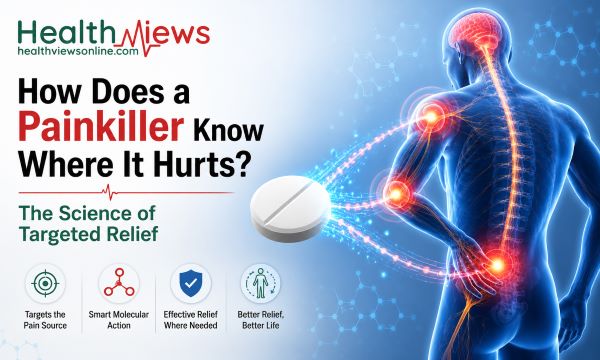
How Does a Painkiller Know Where It Hurts? When you take a pill for a throbbing headache, a sprained ankle, or a toothache, it often feels as though the medication possesses an uncanny intelligence. Within 20 to 30 minutes, the discomfort in that exact spot begins to fade.
This leads to a fascinating question: How does a painkiller actually know where it hurts?
The short answer is: it doesn’t. Painkillers do not have a GPS system, nor do they navigate directly to your site of injury. Instead, they rely on biochemical distribution through your bloodstream and targeted interactions with your nervous system and cellular receptors.
How Does a Painkiller Know Where It Hurts? The Journey of a Painkiller: From Pill to Bloodstream
To understand how pain relief works, it helps to track what happens inside your body after you swallow an over-the-counter (OTC) pill:
- Ingestion & Digestion: The pill travels down your esophagus into your stomach and small intestine, where it dissolves.
- Absorption: The active chemical compounds are absorbed through the intestinal walls into the bloodstream.
- Systemic Distribution: The heart pumps this medicated blood everywhere in your body—from your brain down to your toes.
Because the medication travels universally throughout your vascular system, it reaches healthy tissues and injured tissues simultaneously. However, it only triggers a noticeable physiological response where specific chemical signals of pain are actively being generated.

How Different Painkillers Work at the Cellular Level
To stop pain, different classes of medications use entirely different biochemical strategies.
1. NSAIDs (Ibuprofen, Naproxen, Aspirin) — Blocking the Local Alarm
When tissues are damaged (for instance, a twisted wrist or an inflamed tooth root), the injured cells produce special enzymes called cyclooxygenase (COX-1 and COX-2). These enzymes generate chemical messengers known as prostaglandins.
Prostaglandins perform several roles:
- They cause inflammation and swelling.
- They sensitize local nerve endings, sending electrical pain signals up the spinal cord to the brain.
Non-Steroidal Anti-Inflammatory Drugs (NSAIDs) float through the entire bloodstream, but they specifically bind to and inhibit COX enzymes wherever they find them. By blocking COX enzymes at the site of inflammation, NSAIDs stop the production of new prostaglandins. Without these chemical alarms, the local nerve endings stop sending pain signals to the brain.
Also Read: Now Know 10 Common Medications That Deplete Essential Nutrients in Your Body
2. Acetaminophen (Paracetamol) — Silencing the Central System
Unlike NSAIDs, acetaminophen does not target peripheral inflammation or reduce swelling in injured joints. Instead, scientists believe it acts primarily in the central nervous system (the brain and spinal cord).
Acetaminophen elevates your overall pain threshold by inhibiting COX enzymes in the brain and modulating chemical pathways involved in pain signal transmission. While the chemical circulates everywhere, its primary pain-relieving effect occurs by dampening the brain’s reception of those incoming signals.
3. Opioids (Codeine, Morphine) — Hijacking the Brain’s Receptors
For severe pain, prescription opioids work by binding directly to mu-opioid receptors located on nerve cells in the brain, spinal cord, and gastrointestinal tract.
When opioids bind to these receptors, they block the transmission of pain messages entirely and trigger the release of dopamine. The pain signal may still originate at the site of an injury, but the brain’s ability to perceive or care about that signal is temporarily switched off.
Also Read: AMR – Antimicrobial Resistance: The Next Global Health Crisis
Why Don’t Healthy Organs Suffer?
Since painkillers travel everywhere in the body, why don’t they affect healthy tissues the same way?
They actually do—which explains common side effects:
- Stomach Upset from NSAIDs: COX-1 enzymes also help protect the mucous lining of your stomach. Because NSAIDs block COX enzymes systemically, prolonged use can irritate the stomach lining.
- Drowsiness from Opioids: Mu-opioid receptors exist throughout the brain and digestive system, leading to sedation and constipation alongside pain relief.
The reason you only feel relief at the site of injury is because that is the only location where prostaglandins or active pain signals were being overproduced in the first place.
How Does a Painkiller Know Where It Hurts: The Painkiller Mechanism
┌─────────────────────────────────────────────────────────────┐
│                 HOW PAINKILLERS WORK                        │
├─────────────────────────────────────────────────────────────┤
│  1. Ingestion      ➔ Pill dissolves in stomach/intestines.  │
│  2. Distribution   ➔ Bloodstream carries drug everywhere.   │
│  3. Binding        ➔ Drug binds to specific enzymes/receptors│
│  4. Relief         ➔ Pain signals blocked at source/brain.  │
└─────────────────────────────────────────────────────────────┘
Key References & Scientific Sources
- National Institutes of Health (NIH) / PubChem:Mechanism of Action of Nonsteroidal Anti-inflammatory Drugs (NSAIDs) — Explains COX-1/COX-2 enzyme inhibition and prostaglandin suppression.
- American Medical Association (AMA):Pharmacokinetics and Systemic Distribution of Over-the-Counter Analgesics.
- British Journal of Pharmacology:Understanding the Mechanisms of Action of Paracetamol/Acetaminophen.
- U.S. Food and Drug Administration (FDA):Educational Guide on Analgesics, Opioid Receptors, and Pain Management.
Disclaimer: This article on How Does a Painkiller Know Where It Hurts? is intended for educational purposes only and should not replace clinical medical advice. Always consult a doctor or pharmacist regarding proper medication dosage and potential drug interactions.