

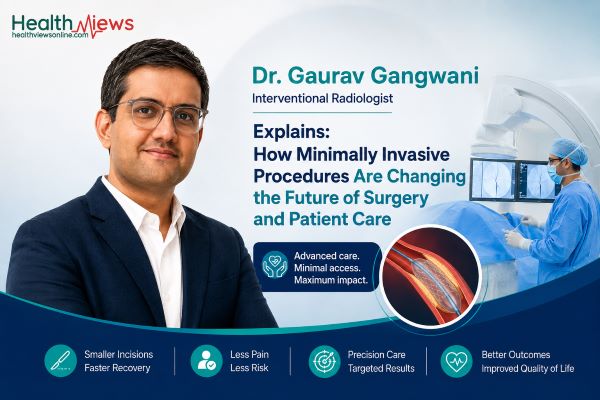
A HealthViews Exclusive with Interventional Radiologist Dr. Gaurav Gangwani, on Image-Guided Treatments, Minimally Invasive Surgery and the Future of Patient Care
For decades, surgery has been one of the most important tools in modern medicine. But advances in medical technology are changing the way many conditions can be diagnosed and treated. Today, patients may have access to procedures that require only a tiny incision or needle puncture instead of traditional open surgery. This is where interventional radiology and minimally invasive procedures are transforming patient care.
Dr. Gaurav Gangwani, an Interventional Radiologist in Mumbai, specialises in image-guided, minimally invasive treatments designed to address a wide range of vascular and non-vascular conditions.
According to Interventional Radiologist Dr. Gaurav Gangwani,
Minimally invasive procedures have become a first line preferred alternative for many vascular and non-vascular conditions or diseases like uterine fibroids, enlarged prostate, varicose veins, thyroid nodules, breast fibroadenomas and many similar medical ailments. They would change the future of patient care as they would change the way healthcare works with most procedures being performed on OPD basis without general anesthesia and no scars or cosmetic sequelae.
What Is Minimally Invasive Treatment?
Minimally invasive medicine refers to procedures performed through very small openings in the body rather than through large surgical incisions.
In interventional radiology, doctors use imaging technologies such as ultrasound, X-ray fluoroscopy and other image-guidance techniques to precisely navigate instruments such as needles and catheters to the area requiring treatment.
According to Interventional Radiologist Dr. Gaurav Gangwani, many of these procedures can be performed through a small puncture in the wrist, thigh or another part of the body, often using local anaesthesia and, in appropriate cases, allowing patients to return home much sooner than they might after conventional surgery.
This combination of precision, technology and targeted treatment is helping expand the possibilities of modern medicine.
From Surgery to Targeted Treatment
One of the biggest advantages of interventional radiology is that treatment can be directed specifically towards the problem area.
For example, uterine fibroid embolisation can be used to treat fibroids by blocking their blood supply, while prostate artery embolisation is an established minimally invasive option for selected men with symptoms related to an enlarged prostate.
Similarly, thyroid nodules can sometimes be treated using radiofrequency or microwave ablation, techniques that target the abnormal tissue without requiring conventional surgery. Dr. Gangwani’s practice lists thyroid nodule ablation among its specialised services and notes that it was among the early centres in Maharashtra to offer microwave ablation for thyroid nodules.
The reason why image-guided treatment is preferable to conventional surgery in appropriately selected patients is because it offers lesser complications, rapid recovery and lesser to negligible need for lifelong medication as after a thyroidectomy.
Minimally Invasive Procedures : What Does This Mean for Patients?
For patients, minimally invasive procedures can offer several potential advantages, depending on the condition, procedure and individual circumstances.
These may include:
- Smaller entry points compared with conventional surgery
- Less tissue disruption
- Reduced post-procedure discomfort in some procedures
- Shorter hospital stays or day-care treatment in appropriate cases
- Faster return to routine activities for selected patients
- Treatment options for patients who may not be ideal candidates for major surgery
However, minimally invasive does not automatically mean risk-free or appropriate for everyone. The right treatment depends on the patient’s diagnosis, medical history, anatomy and overall health.
That is why proper evaluation and patient counselling remain critical.
The Growing Role of Interventional Radiology: Interventional Radiologist Dr. Gaurav Gangwani Explains: How Minimally Invasive Procedures Are Changing the Future of Surgery and Patient Care
Interventional radiology is no longer limited to diagnostic imaging. It has evolved into a treatment-focused specialty that can address complex vascular and non-vascular conditions.
Dr. Gangwani’s clinical practice includes procedures such as peripheral angioplasty, varicocele embolisation, uterine fibroid embolisation, prostate artery embolisation, carotid artery stenting, thrombectomy and thromboaspiration, among several other interventions.
His areas of interest also include thyroid artery embolisation, haemorrhoid embolisation and ablation-based treatments, demonstrating how diverse minimally invasive medicine has become.
The most promising procedures that would become mainstream alternatives in India in near future are:
- Thermal ablation techniques for thyroid nodules, uterine fibroids, breast fibroadenomas
- Embolization procedures – prostate artery embolization for benign prostatic hyperplasia, thyroid artery embolization for large nodules or multi nodular goiter, uterine fibroid embolization for large fibroids or adenomyosis, hemorrhoid embolization for high grade piles and musculoskeletal embolization for conditions like plantar fasciitis, frozen shoulder and knee arthritis.
- Vacuum assisted excision for breast fibroadenomas
Also Read: Medical Tourism in India: Why the World Is Choosing India for Affordable, World-Class Healthcare
Technology Is Changing the Meaning of Surgery
The future of surgery may not necessarily mean eliminating surgery altogether. Instead, the direction of medicine is increasingly about selecting the least invasive effective treatment for the right patient.
Advanced imaging, improved catheters, embolisation materials, ablation technologies and better procedural equipment are allowing specialists to treat conditions with increasing precision.
For interventional radiologists, this means combining medical expertise with technology to reach areas of the body that previously required more invasive approaches.
For patients, it can mean more treatment choices.
Patient Education Is Equally Important
Technology alone cannot transform healthcare. Patients also need to understand their options.
Dr. Gangwani places considerable emphasis on transparent counselling and helping patients understand the potential benefits, risks, success rates, costs and expected recovery associated with different treatment options. His professional profile describes patient communication and informed decision-making as an important part of his approach to care.
This is particularly important when patients hear terms such as “non-surgical” or “minimally invasive”. Every procedure has indications, limitations and potential complications.
Patients need to be precise about their queries to the specialist before choosing these options. They need to ask if they meet the appropriate selection criteria for the procedure chosen, the technical and clinical success rates of the procedure, longevity of the benefits and recurrence rates and timing of the ailment, complication risks- minor and major ones and of course cost of the procedure.
The Future of Minimally Invasive Procedures: More Precise, More Personalised Care
The evolution of minimally invasive medicine represents an important shift in healthcare — from treating the body through large surgical openings towards targeted, image-guided intervention wherever clinically appropriate.
Dr. Gaurav Gangwani’s work in interventional radiology reflects this changing landscape, particularly in areas such as vascular interventions, embolisation and image-guided ablation. His professional profile also highlights academic and research involvement, including indexed research papers, case reports and participation as faculty at national and international medical education programmes.
The future of patient care is unlikely to be defined by one treatment approach. Instead, it will be about giving patients access to the right treatment at the right time — with safety, evidence, precision and quality of life at the centre of decision-making.
As minimally invasive technologies continue to evolve, procedures that once required major surgery may increasingly have less invasive alternatives for appropriately selected patients.
And that could change not only how doctors treat disease, but how patients experience treatment itself.
Also Read: Meet Interventional Radiologist Dr. Gaurav Gangwani of Mumbai
About Interventional Radiologist Dr. Gaurav Gangwani
Dr. Gaurav Gangwani is an Interventional Radiologist based in Mumbai with qualifications including MBBS, DNB Radiodiagnosis and FVIR. His areas of expertise include minimally invasive image-guided interventions, thyroid nodule ablation, thyroid artery embolisation, varicocele embolisation, uterine fibroid embolisation, prostate artery embolization, vacuum assisted excision of breast fibroadenomas and other vascular and non-vascular procedures. He is associated with Lilavati Hospital & Research Centre and other healthcare centres in Mumbai. Follow him on LinkedIn, Google, Instagram.
Disclaimer: This article “Interventional Radiologist Dr. Gaurav Gangwani Explains: How Minimally Invasive Procedures Are Changing the Future of Surgery and Patient Care” is intended for general health education and does not replace an individual medical consultation. The suitability of any minimally invasive procedure depends on the patient’s specific condition and should be determined by a qualified medical professional.