
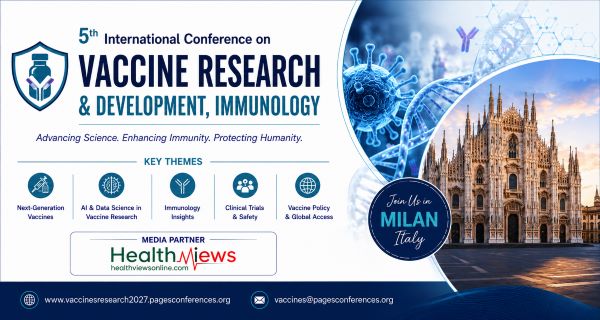
The 5th International Conference on Vaccine Research, Development & Immunology — Vaccines-2027 — will bring vaccine researchers, immunologists, clinicians, industry leaders, policymakers and global-health experts together in Milan on April 19–20, 2027. HealthViews India is proud to be associated with the summit as its Media Partner.
Vaccines have moved far beyond the traditional model of developing a single antigen against a known infectious disease. Today, vaccine science encompasses mRNA and nucleic-acid platforms, reverse vaccinology, immunoinformatics, AI-assisted vaccine design, therapeutic cancer vaccines, personalized immunotherapy, mucosal immunity, novel delivery systems, precision immunology and pandemic preparedness.
At the same time, the global vaccine landscape continues to face major challenges — from emerging and re-emerging pathogens and vaccine hesitancy to equitable access, manufacturing capacity, cold-chain requirements and the need to respond rapidly to future outbreaks.
It is against this backdrop that Vaccines-2027, the 5th International Conference on Vaccine Research, Development & Immunology, will convene the international scientific and healthcare community in Milan, Italy, on April 19–20, 2027.
The conference is organised by Pages Conferences and is being positioned as a global forum for vaccine research, immunology, clinical development, biotechnology, pharmaceutical innovation and global health policy.
HealthViews India is proud to be the Media Partner for Vaccines-2027, helping bring the scientific discussions, developments and opportunities surrounding the summit to a wider healthcare audience in India and beyond.
Vaccines-2027: A Global Meeting for the Next Generation of Vaccine Science
Vaccines-2027 is the 5th edition of the International Conference on Vaccine Research, Development & Immunology.
According to the conference materials, previous editions of the conference series have been held across Spain, Germany, the Netherlands and France, with the 2027 edition moving to Milan, Italy.
The conference is designed around three broad ideas:
- Innovation in vaccine science and technology
- Application of research to real-world healthcare challenges
- Impact on global health.
The organisers describe the summit as a meeting point for researchers, policymakers, clinicians and innovators seeking to address emerging global health challenges and develop preventive strategies for the future.
Over two days, participants will have opportunities to present research, learn about emerging developments, interact with international experts, explore industry connections and develop potential research collaborations.
Complete Details of International Conference Vaccines-2027 in Milan, Italy
| Event Detail | Information |
|---|---|
| Event | 5th International Conference on Vaccine Research, Development & Immunology |
| Short Name | Vaccines-2027 |
| Dates | April 19–20, 2027 |
| Location | Milan, Italy |
| Organiser | Pages Conferences |
| Format | Plenary, keynote, invited and scientific presentations, poster presentations, networking and exhibition |
| Scientific Focus | Vaccine research, development, immunology, infectious diseases, therapeutic vaccines, AI, global health and biomanufacturing |
| Audience | Researchers, immunologists, clinicians, pharmaceutical and biotech professionals, policymakers, academicians, students and global-health organisations |
| Official Website | vaccinesresearch2027.pagesconferences.org |
| Contact | vaccines@pagesconferences.org |
| Media Partner | HealthViews India |
What Will International Conference Vaccines-2027 Cover?
The scientific programme is broad, extending from fundamental immunology and antigen discovery to clinical trials, vaccine manufacturing, AI and global health policy.
The conference brochure identifies eight major scientific tracks:
1. Vaccine Platforms
This track will explore the technologies underpinning next-generation vaccines, including:
- Antigen discovery
- mRNA vaccines
- DNA vaccines
- Viral-vector vaccines
- Vaccine adjuvants
- Next-generation delivery technologies.
The programme also expands into self-amplifying vaccines, nucleic-acid therapeutics, multivalent vaccines, combination vaccines and novel delivery platforms.
2. Immunology & Efficacy
Understanding how the immune system responds to vaccination is central to successful vaccine development.
Topics include:
- T-cell responses
- B-cell responses
- Immune memory
- Translational immunology
- Mechanisms of protection
- Mucosal immunity
- Immunology of infectious diseases
- Immunosenescence and adult vaccination.
Also Read: Everything You Wanted to Know About the 7-Minute Cancer Immunotherapy Injection
3. Therapeutic Vaccines
Vaccines are increasingly being investigated beyond conventional infectious-disease prevention.
Vaccines-2027 will address:
- Cancer vaccines
- Cancer neoantigens
- Personalized vaccines
- Precision immunotherapy
- Therapeutic vaccines for chronic diseases
- Autoimmune diseases.
The inclusion of neoantigen-based personalized immunotherapy highlights the growing intersection between vaccine technology, cancer biology and precision medicine.
4. Emerging Diseases
Emerging and re-emerging infectious diseases remain a major global-health concern.
The scientific programme includes:
- Viral vaccines
- Bacterial vaccines
- Parasitic vaccines
- Emerging pathogens
- Re-emerging pathogens
- Zoonotic diseases
- Vector-borne diseases
- HIV, tuberculosis and malaria vaccines
- RSV, influenza and coronavirus vaccines
- Pandemic vaccines.
Also Read: Russia To Launch Cancer Vaccines
5. AI & Digital Health
Artificial intelligence is becoming increasingly important across the vaccine-development pipeline.
Vaccines-2027 will explore:
- Machine learning in vaccine design
- Bioinformatics
- Big-data analytics
- AI and machine learning in vaccinology
- Systems vaccinology
- Multi-omics
- Digital epidemiology
- Outbreak prediction.
This reflects the expanding role of computational methods in identifying antigens, analysing immune responses, understanding pathogens and anticipating disease outbreaks.
6. Global Health Policy
Scientific innovation alone does not determine whether vaccines reach the people who need them.
The programme therefore includes:
- Regulatory affairs
- Global guidelines
- Vaccine hesitancy
- Public-health communication
- Vaccine equity
- Vaccine access
- Global immunization strategies
- One Health approaches
- Civil-society engagement.
7. Clinical Trials
The development of a vaccine requires rigorous evaluation before it can be translated into widespread use.
This track covers:
- Safety
- Immunogenicity
- Effectiveness
- Preclinical studies
- Animal models
- Clinical trials
- Real-world evidence
- Pharmacovigilance
- Vaccine safety.
8. Biomanufacturing
Developing a successful vaccine is only one part of the challenge. Manufacturing it at scale and distributing it effectively are equally important.
The programme includes:
- Scale-up processes
- Biomanufacturing
- Thermostable vaccines
- Vaccine stability
- Cold-chain innovations
- Rapid-response platforms.
Also Read: Artificial Intelligence in Diagnostics: Is it Time for Your Hospital to Invest?
AI, Bioinformatics and the Future of Vaccinology
One of the most significant developments reflected in the Vaccines-2027 programme is the growing role of artificial intelligence and computational biology.
Traditional vaccine research can involve years of antigen identification, laboratory testing, preclinical research and clinical development.
AI and large-scale biological datasets are opening additional approaches to this process.
The summit specifically includes machine learning in vaccine design, bioinformatics, big-data analytics, systems vaccinology, multi-omics and digital epidemiology.
These areas bring together immunologists, computational biologists, data scientists and vaccine developers.
The programme’s inclusion of outbreak prediction also points to a broader role for digital technologies — not simply designing vaccines, but potentially helping public-health systems anticipate where infectious-disease threats may emerge.
mRNA, DNA and Next-Generation Vaccine Platforms
The Vaccines-2027 programme places considerable emphasis on next-generation vaccine platforms.
These include:
- mRNA vaccines
- Self-amplifying RNA vaccines
- DNA vaccines
- Viral vectors
- Nucleic-acid therapeutics
- Novel adjuvants
- Nanotechnology
- Needle-free delivery
- Oral vaccines
- Nasal vaccines
- Microneedle-based delivery
- Multivalent and combination vaccines.
The programme therefore extends beyond individual vaccine candidates and looks at the underlying platforms that could enable faster, more adaptable and potentially more targeted vaccine development.
Cancer Vaccines and Personalized Immunotherapy
Another important area at Vaccines-2027 is the development of therapeutic vaccines.
The scientific agenda includes:
Cancer vaccines → cancer neoantigens → personalized vaccines → precision immunotherapy.
The concept of using vaccination strategies to stimulate immune responses against tumour-specific targets represents a major area of research within modern immunology.
The conference also includes therapeutic vaccines for chronic diseases and research related to autoimmune diseases.
By bringing infectious-disease vaccinology together with therapeutic immunology, the conference creates a broader discussion around how immune-system modulation can be used across different disease areas.
Pandemic Preparedness and Emerging Infectious Diseases
The COVID-19 pandemic demonstrated the importance of having vaccine-development and manufacturing capabilities that can respond rapidly to emerging pathogens.
Vaccines-2027 therefore places pandemic preparedness and global response among its scientific sessions.
The programme includes:
- COVID-19 and pandemic vaccines
- Emerging and re-emerging pathogens
- Pandemic preparedness
- Global response strategies
- Digital epidemiology
- Outbreak prediction
- Rapid-response vaccine platforms
- One Health
- Zoonotic diseases.
The One Health perspective is particularly relevant because infectious-disease threats can cross boundaries between human, animal and environmental health.
The conference also includes veterinary vaccines and spillover risks, reflecting this interconnected approach.
Vaccine Equity, Hesitancy and Global Health
Scientific innovation must ultimately translate into access.
Vaccines-2027 therefore includes a strong global-health and policy dimension.
Topics include:
- Vaccine hesitancy
- Public-health communication
- Vaccine equity
- Vaccine access
- Global policy
- Global immunization strategies
- Regulatory affairs
- Vaccine safety
- Pharmacovigilance
- Civil-society engagement.
These discussions are important because vaccine impact depends not only on whether a vaccine can be developed, but also on whether people can access it, trust it and receive it through effective health systems.
Distinguished Speakers at Vaccines-2027
The current conference information lists a diverse international group of distinguished speakers.
Among those listed are:
- Dr. Anthony Pilorget CEO – Nevezyne, France
- Dr. Christopher P. Locher CEO – Versatope Therapeutics, USA
- Dr. Kemal Karaca Head of R&D – ZEKO Molecular Vaccines, USA
- Dr. Sasha Shafikhani Professor & Director of Microbiome Research, USA
- Dr. Eric A. Scheinbart Immunity Redefined LLC, USA
- Dr. Frederick Wittke Founder – Arthama GmbH, Switzerland
- Dr. Gautam Sanyal Principal Consultant, Vaccine Analytics, LLC, USA
- Dr. Jocelyn Yelle Founder & President – Antiviral InteliStrat, Canada
- Dr. Jorge E. Osorio CEO – VaxThera, USA
- Dr. Graeme Ladds CEO – PharSafer Associates Ltd, UK
The speaker roster reflects the conference’s intended mix of vaccine development, biotechnology, immunology, analytics, antiviral strategy and pharmaceutical expertise.
Scientific Sessions at Vaccines-2027
Beyond the major tracks, the official conference information lists an extensive range of scientific sessions.
These include:
- Cancer Vaccines & Therapeutic Immunology
- Human Vaccines & Immunotherapeutics
- Infectious Diseases & Immunization
- COVID-19 & Pandemic Vaccines
- Emerging & Re-Emerging Pathogens
- Pandemic Preparedness & Global Response
- RSV, Influenza & Coronavirus Vaccines
- Next-Generation Vaccine Platforms
- Personalized & Precision Vaccines
- Reverse Vaccinology & Immunoinformatics
- Pediatric & Maternal Immunization
- One Health & Zoonotic Diseases
- Veterinary Vaccines & Spillover Risks
- Vaccine Hesitancy & Public Health Communication
- Vector-Borne Disease Vaccines
- Conjugate & HPV Vaccines
- Needle-Free Delivery: Oral, Nasal & Microneedles
- Immunology of Infectious Diseases
- Vaccine Equity, Access & Global Policy
- Pharmacovigilance & Vaccine Safety
- Global Immunization Strategies
- Vaccine Quality & Analytical Technologies
- AI & Machine Learning in Vaccinology
- Systems Vaccinology & Multi-Omics
- mRNA & Self-Amplifying Vaccines
- DNA Vaccines & Nucleic Acid Therapeutics
- Therapeutic Vaccines for Chronic Diseases
- HIV, Tuberculosis & Malaria Vaccines
- Mucosal Immunity & Intranasal Vaccines
- Vaccine Adjuvants & Nanotechnology
- Biomanufacturing & Scale-Up
- Vaccine Stability & Cold Chain Innovations
- Multivalent & Combination Vaccines
- Epitope-Based Vaccines & Antigen Design
- Cancer Neoantigens & Personalized Vaccines
- CRISPR & Gene Editing in Vaccine Development
- Clinical Trials & Real-World Evidence
- Digital Epidemiology & Outbreak Prediction
- Immunosenescence & Adult Vaccination.
The breadth of these sessions means the meeting is not restricted to one stage of the vaccine pipeline. Instead, it covers the journey from antigen discovery and immune mechanisms through clinical trials, manufacturing, regulation, delivery and population-level implementation.
Who Should Attend Vaccines-2027?
The conference is intended for a broad international audience.
The organisers specifically identify:
- Vaccine researchers and immunologists
- Virologists
- Microbiologists
- Molecular biologists
- Infectious-disease specialists
- Epidemiologists
- Clinicians and physicians
- Public-health professionals
- Biotechnology professionals
- Pharmaceutical industry professionals
- Vaccine-development and R&D scientists
- Regulatory-affairs professionals
- Vaccine-safety experts
- Clinical research professionals
- Trial coordinators
- Academicians and professors
- Researchers
- Graduate students
- Postgraduates
- Postdoctoral fellows
- Global-health organisations
- NGOs
- Policymakers
- Data scientists
- Bioinformatics experts.
This multidisciplinary audience is central to the conference’s approach because modern vaccine development increasingly requires collaboration between laboratory science, clinical medicine, computational research, manufacturing and public policy.
Why Attend Vaccines-2027?
The organisers highlight several reasons for participating.
Network with global leaders
Participants can connect with researchers, clinicians, industry professionals and vaccine-development specialists from different countries and institutions.
Learn about emerging research
The conference provides access to presentations and discussions covering current developments across vaccine science and immunology.
Present your research
Researchers can use the conference as an international platform to share their work through oral or poster presentations.
Develop collaborations
The meeting is designed to facilitate interactions that may lead to research partnerships, institutional collaborations and industry connections.
Advance professional knowledge
Keynote and scientific sessions provide opportunities for researchers, students and professionals to expand their understanding of emerging vaccine technologies and immunological approaches.
Opportunities to Present Research
Vaccines-2027 is particularly relevant for researchers who want to share their work with an international audience.
The conference provides opportunities for:
Oral presentations — Present research findings during scientific sessions.
Poster presentations — Showcase research and interact directly with conference participants.
Abstract publication — Speaker and poster packages include inclusion in the conference Abstract Book.
Networking — Meet researchers and professionals working in related areas.
Academic collaboration — Explore potential research and institutional partnerships.
The conference’s call for abstracts covers the full range of scientific themes, from vaccine platforms and immunology to clinical research, AI, manufacturing and global health.
Important Dates for Vaccines-2027
The conference materials contain important deadlines for researchers and delegates.
The brochure lists:
- July 26, 2026 — Early Bird Deadline
- August 19, 2026 — Abstract Deadline
- September 19, 2026 — Standard Registration Deadline
- April 19–20, 2027 — Conference Dates.
However, the conference website’s Important Dates section, as provided in the event information, lists:
- August 19, 2026 — Early Bird Registration
- September 19, 2026 — Abstract Submission
- September 19, 2026 — Standard Registration
- April 19–20, 2027 — Conference.
There is therefore a difference between the brochure and the website regarding the Early Bird and Abstract deadlines.
For researchers planning to submit an abstract or register, this distinction is important. Participants should verify the latest applicable deadline directly through the official Vaccines-2027 website before submitting an abstract or making payment.
Organising Committee
The conference information lists an international organising committee including:
- Prof. Liu Xiangming South-Central Minzu University, China
- Dr. Vlatko Silobrcic University of Zagreb, Croatia
- Dr. Gurkan Ersoy Cyprus International University, Turkey
- Dr. Sveta Mikhlin R&D at Biovac Ltd, Israel
The committee’s international composition reflects the conference’s objective of bringing together expertise from different geographic and scientific backgrounds.
Why Vaccines-2027 Matters for Global Health
The significance of a vaccine conference today extends far beyond vaccine development itself.
Vaccination sits at the intersection of science, public health, economics, policy, manufacturing, technology and community trust.
A successful vaccine programme requires more than identifying an antigen. It requires:
Research → antigen design → immunological understanding → preclinical testing → clinical trials → regulatory evaluation → manufacturing → quality control → distribution → public acceptance → equitable access.
Vaccines-2027’s programme touches almost every stage of this pathway.
From reverse vaccinology and epitope design to AI and multi-omics, from clinical trials and pharmacovigilance to biomanufacturing and cold-chain innovation, the conference brings different parts of the vaccine ecosystem into the same conversation.
Its inclusion of vaccine hesitancy, equity, global policy and public communication also recognises that scientific breakthroughs must ultimately be translated into effective population-level health outcomes.
A Strong Focus on One Health and Pandemic Preparedness
The inclusion of One Health, zoonotic diseases, veterinary vaccines and spillover risks is another important feature of the scientific agenda.
Many infectious diseases do not exist exclusively within human populations. Interactions between humans, animals and the environment can influence the emergence and spread of infectious threats.
This makes collaboration between veterinary science, human medicine, epidemiology, microbiology, immunology and public health increasingly important.
Vaccines-2027’s pandemic-preparedness sessions place these issues alongside emerging pathogens, outbreak prediction and rapid-response vaccine platforms.
HealthViews India: Bringing the Vaccine Conversation to a Wider Audience
As the Media Partner for Vaccines-2027, HealthViews India is pleased to support the wider dissemination of information around the conference.
For India’s healthcare ecosystem, vaccine research has particular relevance.
The country has a large scientific, pharmaceutical and biotechnology community working across vaccines, infectious diseases, clinical research, manufacturing, immunology, public health and biotechnology.
International conferences such as Vaccines-2027 can provide opportunities for researchers and professionals to engage with global developments, exchange ideas and explore collaborations across borders.
Through its media partnership, HealthViews India will help bring the event’s themes and scientific conversations to healthcare professionals, researchers, academics, students and health-technology stakeholders across India and beyond.
The Road to Milan
Vaccines-2027 arrives at a time when the vaccine landscape is becoming increasingly sophisticated.
The next generation of vaccines is being shaped by mRNA technologies, AI, computational immunology, personalized medicine, novel delivery systems, therapeutic vaccination, multi-omics, advanced manufacturing and precision immunology.
At the same time, global health systems must continue to address more familiar but equally challenging issues: vaccine access, hesitancy, safety, equity, manufacturing capacity and preparedness for emerging infectious diseases.
Bringing these scientific and policy conversations together is the central opportunity presented by Vaccines-2027.
For a vaccine researcher, it can be a platform to present new findings.
For a student or early-career scientist, it can provide international exposure.
For a clinician or public-health professional, it can offer insight into emerging vaccine technologies and immunological research.
For biotechnology and pharmaceutical companies, it can provide opportunities for networking, exhibition and collaboration.
And for policymakers and global-health organisations, it offers a forum to discuss how scientific advances can contribute to stronger immunization strategies.
Vaccines-2027: The Global Vaccine Research Summit at a Glance
| Event Detail | Information |
|---|---|
| Event | 5th International Conference on Vaccine Research, Development & Immunology |
| Short Name | Vaccines-2027 |
| Dates | April 19–20, 2027 |
| Location | Milan, Italy |
| Organiser | Pages Conferences |
| Scientific Focus | Vaccine research, development, immunology and global health |
| Major Themes | mRNA, DNA, viral vectors, cancer vaccines, immunology, emerging diseases, AI, clinical trials, biomanufacturing, global health policy and more |
| Additional Areas | Pandemic preparedness, One Health, vaccine equity, vaccine hesitancy, cold chain, pharmacovigilance and digital epidemiology |
| Speaker Registration | US$749 Early Bird |
| Delegate Registration | US$899 Early Bird |
| Poster Registration | US$449 Early Bird |
| Student Registration | US$299 Early Bird |
| Platinum Sponsorship | US$5,000 |
| Gold Sponsorship | US$4,000 |
| Silver Sponsorship | US$3,000 |
| Exhibitor | US$2,000 |
| Abstract Submission | Through the official Vaccines-2027 website |
| Conference Email | vaccines@pagesconferences.org |
| Official Website | vaccinesresearch2027.pagesconferences.org |
| Media Partner | HealthViews India |
Note: Registration fees, deadlines, programme details and speaker information may be updated by the organisers. The official conference website should be checked for the latest information before registration, abstract submission, travel arrangements or payment.
Source note: This article is based primarily on the Vaccines-2027 conference website information and the brochure/details supplied for this article. Where the brochure and website display different deadlines, both have been identified rather than silently reconciling them. The organisers’ website should be treated as the latest source for registration and submission updates.