

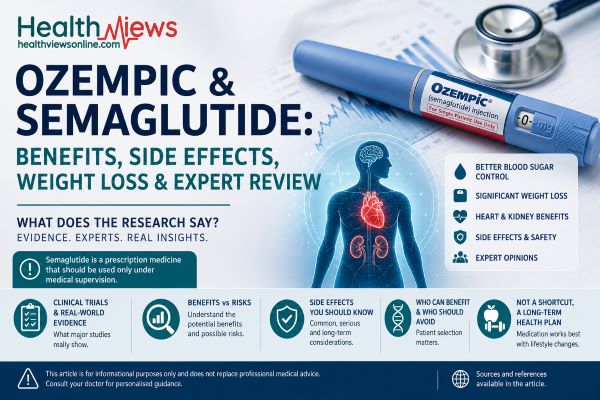
From clinical trials and regulatory documents to Indian endocrinologists and doctors discussing GLP-1 medicines in public forums, this review examines what Ozempic and semaglutide can — and cannot — do.
The name Ozempic has become almost synonymous with weight loss. What began as a prescription medicine for type 2 diabetes has moved into mainstream conversations about obesity, celebrity weight loss, social media trends and “skinny injections.”
But the science is considerably more nuanced than the social-media narrative.
Ozempic contains semaglutide, a glucagon-like peptide-1 (GLP-1) receptor agonist. It was developed primarily to improve blood glucose control in people with type 2 diabetes. Higher-dose semaglutide, marketed as Wegovy, is used for chronic weight management in eligible people with overweight or obesity.
Clinical trials have shown substantial benefits in appropriate patients. At the same time, semaglutide is not a cosmetic shortcut, it does not eliminate the need for lifestyle management, and stopping treatment can result in significant weight regain.
So, what does the research actually tell us?
First, What Exactly Is Ozempic?
Ozempic is a prescription medicine containing semaglutide, a long-acting GLP-1 receptor agonist.
GLP-1 is a naturally occurring hormone involved in glucose regulation, appetite and digestion. Semaglutide activates the GLP-1 receptor, helping increase insulin secretion when blood glucose is elevated, reduce glucagon secretion and slow gastric emptying. It also acts on appetite-regulating pathways, which can reduce hunger and food intake.
The US prescribing information lists Ozempic for use with diet and exercise to improve blood glucose in adults with type 2 diabetes. It also carries cardiovascular and kidney-related indications for specific groups of adults with type 2 diabetes. (DailyMed)
The distinction between Ozempic and Wegovy matters. They contain the same active molecule, but the products have different approved indications and dosing regimens. Higher-dose semaglutide at 2.4 mg weekly was specifically studied for chronic weight management. (New England Journal of Medicine)
In India, the regulatory landscape has also been evolving rapidly. CDSCO documents show approvals and regulatory activity involving injectable and oral semaglutide, while India’s obesity guidelines recognise injectable semaglutide 2.4 mg as an approved option for obesity management. (PubMed Central (PMC))
What Happens to the Body After Taking Semaglutide?
Ozempic and Semaglutide essentially acts on several metabolic pathways at the same time.
1. It improves glucose control
By enhancing glucose-dependent insulin secretion and reducing inappropriate glucagon secretion, semaglutide lowers blood glucose levels in people with type 2 diabetes.
2. Ozempic reduces appetite
GLP-1 signalling affects areas of the brain involved in appetite and food intake. Patients commonly report feeling fuller sooner and experiencing less hunger.
3. It slows gastric emptying
Food moves more slowly through the stomach, contributing to increased satiety.
4. It can lead to substantial weight loss
This is where the drug has attracted enormous attention.
But the amount of weight loss depends on the formulation, dose, duration of treatment, baseline characteristics and whether the person has diabetes.
How Much Weight Can Ozempic Actually Reduce?
One of the landmark studies was the STEP 1 trial, published in the New England Journal of Medicine in 2021.
The trial included 1,961 adults with overweight or obesity who did not have diabetes. Participants received either semaglutide 2.4 mg once weekly or placebo, alongside lifestyle intervention, for 68 weeks.
The average weight change was:
- −14.9% with semaglutide
- −2.4% with placebo
The estimated difference between the groups was 12.4 percentage points. (New England Journal of Medicine)
This was a major finding because the magnitude of weight reduction was considerably greater than that seen with many older anti-obesity medicines.
However, there is an important caveat: the STEP 1 trial used semaglutide 2.4 mg, the dose associated with the weight-management indication. It should not automatically be assumed that every person taking Ozempic at diabetes doses will experience the same percentage of weight loss.
Also Read: How to Break Through a Weight Loss Plateau
Is the Weight Loss by Ozempic Mainly Fat?
Not entirely.
This is an important issue that often gets overlooked in social-media discussions.
When body weight falls rapidly, some of the reduction can come from lean mass as well as fat mass. This does not mean semaglutide is uniquely harmful to muscle; loss of lean tissue can accompany substantial weight loss from many interventions.
However, it means that protein intake, resistance exercise, adequate nutrition and appropriate medical monitoring become particularly important, especially for older adults or people who are already at risk of low muscle mass.
This concern is especially relevant in South Asian populations.
In a discussion with The Indian Express, endocrinologist Dr Shashank Joshi, Consulting Endocrinologist at Lilavati Hospital, Mumbai, highlighted the “thin-fat” phenotype seen in many Indians — where metabolic risk and visceral fat can be present even when overall body weight does not appear very high. He cautioned that disproportionate loss of lean mass could potentially contribute to frailty or functional deterioration, particularly in older adults. (The Indian Express)
Dr Joshi also argued against self-directed “microdosing” and emphasised medical supervision. (The Indian Express)
What Happens When You Stop Taking Semaglutide?
This may be one of the most important questions for anyone considering the drug.
The answer from research is clear: weight regain is common after treatment is stopped.
A follow-up analysis of STEP 1 participants examined what happened after semaglutide was discontinued.
After 68 weeks of treatment, participants in the extension had lost an average of 17.3% of their initial body weight. Following treatment withdrawal, they regained an average of 11.6 percentage points of body weight over the following year.
In other words, participants regained approximately two-thirds of the weight they had previously lost.
Many cardiometabolic improvements also moved back toward baseline after treatment was discontinued. (PubMed Central (PMC))
This does not mean that semaglutide “doesn’t work.”
Rather, it supports an important medical concept: obesity is a chronic disease, and weight regulation is biologically defended by the body.
Dr AG Unnikrishnan, Chief Executive Physician and diabetologist associated with Chellaram Diabetes Institute, told The Indian Express that diabetes and obesity are chronic conditions and that treatment duration should be determined by whether benefits continue, rather than assuming everyone should simply stop after reaching a target weight. He also emphasised combining medication with diet and exercise. (The Indian Express)
Does Ozempic Protect the Heart?
The answer is more complicated than simply saying “yes.”
Semaglutide has demonstrated cardiovascular benefits in several populations.
SUSTAIN-6: People With Type 2 Diabetes
In the SUSTAIN-6 cardiovascular outcomes trial, semaglutide was studied in people with type 2 diabetes at high cardiovascular risk.
The trial helped establish cardiovascular safety and found a lower rate of major cardiovascular events with semaglutide compared with placebo. (New England Journal of Medicine)
SELECT: People With Overweight or Obesity Without Diabetes
The SELECT trial was particularly important because it examined people with established cardiovascular disease who had overweight or obesity but did not have diabetes.
Among 17,604 participants, a major cardiovascular event occurred in:
- 6.5% of the semaglutide group
- 8.0% of the placebo group
This represented a 20% relative reduction in the primary composite cardiovascular outcome of cardiovascular death, non-fatal heart attack or non-fatal stroke. (New England Journal of Medicine)
However, the result should not be interpreted as meaning that semaglutide is automatically a cardiovascular-prevention drug for every overweight person.
The SELECT population had specific characteristics, including established cardiovascular disease.
Ozempic and Kidney: What About the Kidneys?
The evidence has also expanded into kidney disease.
The FLOW trial, published in The New England Journal of Medicine in 2024, studied people with type 2 diabetes and chronic kidney disease.
Among 3,533 participants, semaglutide reduced the risk of the primary composite kidney outcome by 24% compared with placebo.
The trial also reported:
- 18% lower risk of major cardiovascular events
- 20% lower risk of death from any cause
- slower decline in estimated kidney function
The authors concluded that semaglutide reduced clinically important kidney outcomes and cardiovascular death in this high-risk population. (New England Journal of Medicine)
It is important to note that FLOW was funded by Novo Nordisk, the manufacturer of semaglutide. That does not invalidate the findings, but it is relevant when assessing the evidence alongside independent studies and systematic reviews. (New England Journal of Medicine)
What Are the Most Common Side Effects of Ozempic?
The most frequently reported adverse effects are gastrointestinal.
These include:
- Nausea
- Vomiting
- Diarrhoea
- Constipation
- Abdominal discomfort
- Reduced appetite
These symptoms are often most noticeable during dose escalation.
The FDA prescribing information also contains warnings concerning pancreatitis, diabetic retinopathy complications, acute kidney injury, gallbladder disease, hypoglycaemia when used with certain diabetes medicines, hypersensitivity reactions and severe gastrointestinal reactions. (U.S. Food and Drug Administration)
This is why the drug should not be treated like an ordinary dietary supplement.
What Do Indian Doctors Say About Ozempic?
The growing use of semaglutide in India has prompted endocrinologists to address both its potential and its misuse.
Dr Ambrish Mithal: Not a Cosmetic Shortcut
Dr Ambrish Mithal, Group Chairman of Endocrinology and Diabetes at Max Healthcare, has repeatedly discussed GLP-1 medicines and their role in diabetes and obesity management.
In an India Today discussion, he explained that Ozempic belongs to the GLP-1 agonist class and described how the pathway works in relation to insulin and glucose metabolism. (India Today)
In a separate 2025 discussion, he stressed that GLP-1 medicines should not be treated as simple cosmetic solutions and discussed concerns surrounding inappropriate use, muscle loss and social-media-driven expectations. (India Today)
A 2026 episode featuring Dr Mithal specifically examined Ozempic, Mounjaro, obesity, side effects, muscle loss, patient selection, microdosing and long-term safety. The programme’s public notes also direct viewers to his Instagram account, providing a social-media-linked source for his public discussion of the subject. (YouTube)
Dr Mithal has also co-authored Indian real-world research on oral semaglutide in type 2 diabetes. (PubMed Central (PMC))
Qualification: Dr Ambrish Mithal is a senior endocrinologist and currently Group Chairman, Endocrinology and Diabetes, Max Healthcare, New Delhi. His published academic work lists him with the Department of Endocrinology and Diabetes at Max Super Speciality Hospital, Saket. (PubMed Central (PMC))
Dr Anoop Misra: Benefits Need to Be Balanced With Safety
Dr Anoop Misra, Chairman of Fortis-CDOC Center of Excellence for Diabetes, Metabolic Diseases and Endocrinology, New Delhi, has also commented extensively on the rapidly expanding use of GLP-1 medicines.
In a 2026 NDTV discussion, he addressed the use of weight-loss injections in people with diabetes, including patients who may not appear obese but can have significant metabolic risk. (NDTV)
Dr Misra has also co-authored recent research examining semaglutide’s potential relevance to abdominal adiposity and liver disease in Asian Indians. (PubMed)
His broader research has consistently highlighted the distinctive metabolic phenotype of South Asians, including greater abdominal and ectopic fat at comparatively lower BMI. (BMJ)
Qualification: Dr Misra trained at AIIMS, New Delhi, and subsequently worked at institutions including Royal Free Hospital in London and the University of Texas Southwestern Medical Center. He has more than four decades of experience in diabetes and metabolic medicine and has authored hundreds of scientific papers and chapters. (BMJ)
Dr Subhash Wangnoo: The Problem Is Casual Use of Ozempic
Dr Subhash Wangnoo, senior endocrinologist at Apollo Hospitals, Delhi, has been particularly vocal about unsupervised use.
In an interview with The Indian Express, he described increasingly common situations in which patients told him they had started semaglutide after seeing it on Instagram.
His central concern was not that the medicine itself was inherently inappropriate, but that people were starting it without adequate assessment, dose planning or follow-up. (The Indian Express)
He has also written publicly about the expansion of GLP-1 access in India following the expiry of semaglutide’s patent and the need to balance affordability with clinical safety and regulatory oversight. (The Indian Express)
Qualification: Dr Wangnoo holds MBBS, MD (Medicine), DM and FRCP qualifications and has more than four decades of experience in endocrinology. Apollo Hospitals lists him as an experienced endocrinologist and describes his leadership of its Centre for Obesity, Diabetes and Endocrinology. (Apollo Hospitals)
Dr AG Unnikrishnan: Don’t Assume Everyone Can Simply Stop
Dr AG Unnikrishnan, an endocrinologist associated with Chellaram Diabetes Institute, has highlighted another important issue: treatment duration.
In comments to The Indian Express, he said diabetes and obesity are chronic conditions and that continuation or dose reduction needs to be individualised rather than governed by a single universal stopping protocol. He also stressed the importance of diet and exercise alongside medication. (The Indian Express)
His comments broadly align with the STEP withdrawal data, which showed substantial weight regain after semaglutide was stopped. (PubMed Central (PMC))
What About Instagram and Social-Media Advice on Ozempic?
This is where the Ozempic story becomes particularly complicated.
Social media has played a major role in turning a prescription metabolic medicine into a lifestyle trend.
The problem is not simply that doctors or patients discuss semaglutide online. Public medical education can be useful.
The problem arises when short videos reduce a complex prescription treatment to:
“Take this injection and lose weight.”
Dose selection, medical history, diabetes status, kidney function, gastrointestinal problems, gallbladder history, retinopathy, other medicines, nutritional status and pregnancy plans can all influence whether semaglutide is appropriate.
Public discussions featuring qualified endocrinologists — including Dr Ambrish Mithal — have increasingly tried to counter this simplified narrative by discussing who may benefit, who may not, side effects, muscle preservation and the importance of medical supervision. (YouTube)
For HealthViews readers, an important distinction is therefore:
A doctor’s social-media post is a source of expert commentary — not a substitute for an individual medical consultation.
Is Ozempic a “Magic Weight-Loss Injection”?
No.
But calling it a “scam” or saying that it “doesn’t work” would be equally inaccurate.
The evidence shows that semaglutide can produce substantial weight loss in appropriately selected people and can improve several cardiometabolic outcomes.
The STEP 1 trial demonstrated significant weight reduction. (New England Journal of Medicine)
SELECT demonstrated a reduction in major cardiovascular events in a specific high-risk population with overweight or obesity and established cardiovascular disease but without diabetes. (New England Journal of Medicine)
FLOW demonstrated kidney and cardiovascular benefits in people with type 2 diabetes and chronic kidney disease. (New England Journal of Medicine)
At the same time, withdrawal studies demonstrate that much of the weight can return after stopping treatment. (PubMed Central (PMC))
The more accurate description is therefore:
Semaglutide is a powerful medical treatment for selected metabolic conditions — not a shortcut to cosmetic weight loss.
Who May Be Considered for Treatment?
Eligibility depends on the specific product, indication, country and clinical circumstances.
For chronic weight management, clinical trials and obesity guidelines generally focus on people with obesity or overweight accompanied by weight-related medical conditions.
The 2025 Indian obesity guidelines recognise semaglutide as an effective GLP-1 receptor agonist for obesity management. (PubMed Central (PMC))
However, BMI alone is not enough to decide whether someone should take the drug.
A doctor may also consider:
- Type 2 diabetes
- Prediabetes
- Cardiovascular disease
- Hypertension
- Dyslipidaemia
- Sleep apnoea
- Kidney disease
- Fatty liver/MASH
- Existing gastrointestinal problems
- Gallbladder disease
- Diabetes-related eye disease
- Current medicines
- Pregnancy or plans for pregnancy
- Nutritional and muscle status
- Previous weight-management attempts
Who Should Not Self-Start Semaglutide?
Self-medication is particularly problematic because semaglutide is a prescription drug with dose-escalation requirements and clinically important contraindications and warnings.
The FDA prescribing information says Ozempic should not be used in people with a personal or family history of medullary thyroid carcinoma or in people with MEN 2. It also contains warnings concerning pancreatitis, gallbladder disease, diabetic retinopathy, kidney injury, hypoglycaemia with certain diabetes medicines and severe gastrointestinal reactions. (U.S. Food and Drug Administration)
Pregnancy is another important consideration. The FDA medication information advises patients planning pregnancy to discuss treatment with their healthcare provider and to discontinue semaglutide sufficiently in advance because of its long half-life. (FDA Access Data)
The Indian Context: Why the Conversation Is Different
India presents a particularly interesting case for GLP-1 medicines.
South Asians can develop metabolic disease at lower BMI levels than many Western populations, with relatively high levels of abdominal and ectopic fat and comparatively lower skeletal muscle mass.
Recent research and reviews involving Indian experts have highlighted these differences. (BMJ)
This means that simply importing Western ideas about “ideal weight” or using celebrity transformations as benchmarks can be misleading.
An Indian patient may have significant metabolic risk despite not appearing dramatically overweight.
Conversely, a relatively lean person may not be an appropriate candidate for a weight-loss drug simply because they want to lose a few kilograms.
That distinction is central to responsible prescribing.
The Affordability Question
Semaglutide has historically been expensive, limiting access for many Indian patients.
India’s semaglutide market has changed significantly with the arrival of additional manufacturers and generic versions. Reuters reported in January 2026 that Indian companies had begun receiving regulatory approvals for generic semaglutide products following the expected expiry of Novo Nordisk’s patent protection. (Reuters)
Greater affordability could be beneficial for patients who genuinely need treatment.
But lower prices can also increase inappropriate demand.
In March 2026, The Indian Express reported that India’s drug regulator had intensified surveillance of pharmacies, online platforms, wholesalers, retailers and wellness clinics amid concerns about unauthorised sale and promotion of semaglutide. (The Indian Express)
The challenge for India is therefore twofold:
Make evidence-based treatment more accessible — while preventing a prescription medicine from becoming a lifestyle commodity.
What the Evidence Supports — and What It Doesn’t
| Question | What the evidence suggests |
|---|---|
| Does semaglutide cause weight loss? | Yes, substantial weight loss has been demonstrated, particularly at the 2.4 mg weight-management dose. |
| Does it improve blood sugar? | Yes, it is an established GLP-1 treatment for type 2 diabetes. |
| Does it reduce cardiovascular risk? | Yes, in specific studied populations. |
| Does it provide kidney benefits? | Yes, evidence supports benefit in certain people with type 2 diabetes and CKD. |
| Does everyone lose 15–20% of their weight? | No. Trial averages should not be treated as individual guarantees. |
| Can weight return after stopping? | Yes. Significant regain was documented after withdrawal. |
| Is nausea common? | Yes. Gastrointestinal symptoms are among the most common adverse effects. |
| Is it a cosmetic treatment? | No. It is a prescription medicine for specific medical indications. |
| Can people self-dose based on Instagram advice? | No. Dose selection and escalation require clinical supervision. |
| Is lifestyle change still important? | Yes. Clinical trials and expert guidance use medication alongside diet, physical activity and broader obesity care. |
HealthViews Verdict: Hope, But Not Hype
The Ozempic story is neither a miracle nor a medical failure.
Semaglutide is one of the most important developments in modern metabolic medicine, with high-quality clinical trials demonstrating meaningful effects on blood glucose, body weight and, in specific populations, cardiovascular and kidney outcomes.
But the same evidence also tells us something less glamorous.
The treatment may need to be continued for ongoing benefit. Side effects need monitoring. Weight can return after discontinuation. Lean mass needs attention during substantial weight loss. Certain patients should avoid the drug. And the medicine needs to be prescribed and monitored by an appropriately qualified healthcare professional.
The biggest danger may therefore not be semaglutide itself, but the gap between evidence-based medicine and social-media medicine.
A prescription drug that took years of research and large clinical trials to develop should not be reduced to a 30-second reel promising a smaller waist.
For someone with obesity, type 2 diabetes or related metabolic disease, semaglutide may be an important treatment option.
For someone looking for a quick cosmetic transformation, the medical evidence does not justify treating it as a shortcut.
The right question is not “How quickly can Ozempic make me lose weight?”
It is:
“Do I have a medical reason to use semaglutide, and can it be used safely as part of a long-term treatment plan?”
Medical and Scientific Sources
- Wilding JPH et al. Once-Weekly Semaglutide in Adults with Overweight or Obesity. New England Journal of Medicine, 2021. STEP 1 trial. (New England Journal of Medicine)
- Lincoff AM et al. Semaglutide and Cardiovascular Outcomes in Obesity without Diabetes. New England Journal of Medicine, 2023. SELECT trial. (New England Journal of Medicine)
- Perkovic V et al. Effects of Semaglutide on Chronic Kidney Disease in Patients with Type 2 Diabetes. New England Journal of Medicine, 2024. FLOW trial. (New England Journal of Medicine)
- Marso SP et al. Semaglutide and Cardiovascular Outcomes in Patients with Type 2 Diabetes. New England Journal of Medicine, 2016. SUSTAIN-6. (New England Journal of Medicine)
- Wilding JPH et al. Weight regain and cardiometabolic effects after withdrawal of semaglutide. Diabetes, Obesity and Metabolism, 2022. (PubMed Central (PMC))
- US Food and Drug Administration. Ozempic prescribing information and safety information. (U.S. Food and Drug Administration)
- Endocrine Society of India. Clinical Practice Guidelines for the Evaluation and Management of Obesity in India – An Update, 2025. (PubMed Central (PMC))
- Gupta S, Makkar BM, Kesavadev J, et al. Semaglutide Hype or Hope: Evidence-based Review in Diabesity. Journal of the Association of Physicians of India, 2026. (Journal API)
- Dutta A, Mahendru S, Sharma R, Mithal A. Effectiveness of Oral Semaglutide in Management of Type 2 Diabetes: A Real-World Study from India. Indian Journal of Endocrinology and Metabolism, 2024. (PubMed Central (PMC))
- Ghosh A, Misra A. From abdominal adiposity to liver fibrosis: Expanding promise of semaglutide for Asian Indians. Indian Journal of Gastroenterology, 2025. (PubMed)
- Indian Express. Expert discussion with Dr Shashank Joshi and Dr AG Unnikrishnan on semaglutide use in Indians, dosing, side effects, muscle loss and long-term treatment. (The Indian Express)
- Indian Express. Interview with Dr Subhash Wangnoo on unsupervised use of semaglutide after exposure to Instagram and social-media content. (The Indian Express)
- India Today. Expert discussion with Dr Ambrish Mithal on GLP-1 medicines, obesity treatment and precautions. (India Today)
- NDTV. Expert discussion with Dr Anoop Misra on weight-loss injections and their use in diabetes. (NDTV)
- Central Drugs Standard Control Organisation (CDSCO), India. Regulatory documents relating to semaglutide and obesity treatment. (CDSCO)
Editorial Note
HealthViews Online has reviewed published clinical evidence, regulatory documents and publicly available statements/interviews from qualified medical professionals for this article. The inclusion of a doctor’s comments does not constitute an endorsement of any particular brand or treatment. Individual treatment decisions should be made with a qualified healthcare professional based on the patient’s medical history, indication and risk profile.