

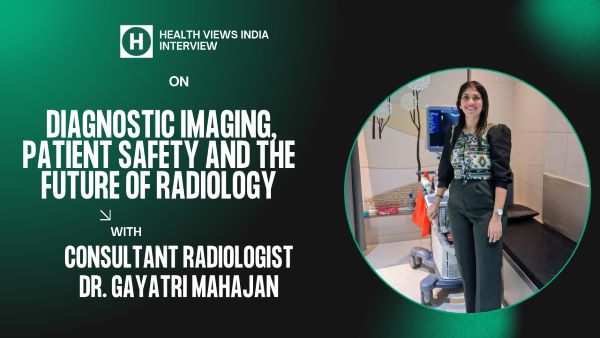
Radiology plays a vital role in modern healthcare, helping doctors diagnose diseases, assess injuries and plan treatment. Beyond interpreting medical images, radiologists must exercise clinical judgement, communicate findings clearly and prioritise patient safety.
In this exclusive HealthViews interview, Consultant Radiologist Dr. Gayatri Mahajan, the founder of Dr. Gayatri’s Diagnostic Centre in Sion Koliwada, Mumbai, discusses her professional journey, accessible diagnostics, pregnancy sonography, radiation safety and the growing role of artificial intelligence (AI) in radiology.
Q1. Consultant Radiologist Dr. Gayatri Mahajan, How has your professional journey shaped your approach to radiology and patient care?
Dr. Gayatri Mahajan: I completed my MBBS and Diploma in Radiodiagnosis from Somaiya Hospital, Mumbai. My experience includes working at BARC Hospital, Sion Hospital, ESIC Hospital, Hiranandani Hospital and Jaslok Hospital.
After my training, I practised in rural areas outside Pune, where I continued working during COVID-19. I witnessed how difficult it could be for families to access quality diagnostic services and understand their medical conditions.
My father always taught me to work for less privileged people, and that influenced my outlook. When I returned to Mumbai, I wanted to work where ordinary families needed accessible healthcare. For me, bridging that gap is important. As Khalil Gibran said, “Work is love made visible.”
Q2. What inspired you to establish Dr. Gayatri’s Diagnostic Centre in Sion Koliwada?
Dr. Mahajan: My brother lives in this area, so I used to visit frequently. People gradually began recognising me and approaching me with health-related questions.
I remember a young woman worried about getting an early pregnancy scan. There was no convenient diagnostic centre nearby, and she had to travel to Sion Circle.
I wondered why accessing a basic sonography examination should be so difficult for a pregnant woman. That experience helped inspire us to bring diagnostic services closer to the community.
Sion Koliwada has many young families, and I felt there was a genuine need for a centre where women could access appropriate investigations without unnecessary travel and long waiting times.
Q3. Many women fear that sonography during early pregnancy could harm their baby. What do you tell them?
Dr. Mahajan: One of the most common questions I hear is, “Doctor, will the ultrasound waves harm my baby?”
Ultrasound uses high-frequency sound waves, not ionising radiation. When medically indicated and performed appropriately, it is considered safe during pregnancy.
X-rays and CT scans use ionising radiation, so their use during pregnancy requires careful clinical justification and consideration of alternatives. MRI does not use ionising radiation and may be considered when additional information is needed, depending on the clinical situation.
Ultrasound is also widely used in children because it does not involve ionising radiation. However, every investigation should have a valid clinical purpose.
My message to expectant mothers is not to let misinformation create unnecessary fear. If your doctor recommends a scan, ask questions and understand why it is needed.
Q4. What makes your diagnostic centre different from larger hospitals in Sion?
Dr. Mahajan: I believe accessibility and trust make a difference. At our centre, patients can speak directly to me, ask questions and understand their investigations without feeling rushed.
A pregnant woman might ask, “Doctor, is everything okay?” I can explain the examination and discuss the findings appropriately.
We also understand that healthcare expenses can be difficult for some families. Wherever feasible, we try to accommodate patients who are struggling financially.
One elderly woman told me she had taken two buses to get her daughter’s scan done. Experiences like these remind me that access to healthcare involves more than medical technology. Distance, transport costs and waiting times can all become barriers.
I wanted to establish a centre where women could feel comfortable, communicate in a language they understand and receive appropriate diagnostic services close to home.
Q5. How do you keep diagnostic services affordable without compromising quality?
Dr. Mahajan: I have never believed that excessive profits should be the primary objective of running a diagnostic centre. If the centre earns a reasonable profit, remains sustainable and allows us to continue serving patients, I am satisfied.
My happiness comes from the work I do. When a mother returns and says, “Doctor, you explained everything so well; now I am not scared,” that gives me tremendous satisfaction.
I also try to improve my knowledge through conferences, research activities and continued learning.
Affordability must go hand in hand with quality, appropriate equipment, trained professionals and patient safety. If I can sustain the centre, support my staff and help families access the investigations they need, that is meaningful work to me.
Q6. What are the biggest challenges in radiology, particularly when choosing further investigations?
Dr. Mahajan: One important responsibility is selecting the appropriate next investigation when an initial scan identifies something requiring further evaluation.
Depending on the clinical question, ultrasound, MRI, CT or another investigation may be appropriate. The decision should account for the benefits and limitations of each modality.
Radiology follows the principle of ALARA—As Low As Reasonably Achievable. This means minimising radiation exposure while obtaining images adequate for diagnosis.
X-rays and CT scans can be extremely valuable, but their use should be justified and doses optimised, particularly in children and patients requiring repeated imaging.
This does not mean avoiding every test involving radiation. When an investigation is medically necessary, its benefits and risks must be assessed appropriately. Patient safety comes first, and unnecessary investigations should be avoided.
Q7. How is artificial intelligence changing radiology, and can it replace radiologists?
Dr. Mahajan: AI has the potential to assist with image analysis, measurements, detection of selected abnormalities and workflow prioritisation. These applications may help radiologists manage workloads and identify cases requiring closer attention.
However, AI systems have limitations. Their performance can vary across patient populations, imaging equipment and clinical settings. They may miss abnormalities or generate incorrect findings.
I see AI as a support tool rather than a replacement for radiologists. Clinical judgement, experience and the ability to interpret images alongside a patient’s symptoms and medical history remain essential.
Technology is most useful when it strengthens responsible medical decision-making while keeping professional oversight and patient safety at the centre.
Q8. What advice would you give patients undergoing diagnostic imaging and aspiring radiologists?
Dr. Mahajan: Patients should understand why an investigation has been recommended, follow preparation instructions and share relevant medical history and previous imaging reports.
More scans do not automatically mean better healthcare. The right investigation, performed at the appropriate time and interpreted accurately, is what matters. Patients should discuss their reports with qualified healthcare professionals rather than drawing conclusions from isolated medical terms online.
For aspiring radiologists, technical expertise must go hand in hand with compassion, continuous learning and a commitment to patient safety.
My journey has reinforced the importance of making diagnostic services accessible to people who might otherwise struggle to obtain them. Quality healthcare should not depend solely on a person’s financial circumstances.
About Consultant Radiologist Dr. Gayatri Mahajan
Dr. Gayatri Mahajan is a Consultant Radiologist with an MBBS and Diploma in Radiodiagnosis from Somaiya Hospital, Mumbai. Her clinical experience includes BARC Hospital, Sion Hospital, ESIC Hospital, Hiranandani Hospital and Jaslok Hospital. She has pursued a fellowship in paediatric imaging through Apollo Radiology International and additional training in musculoskeletal interventions through the Indian Radiological and Imaging Association (IRIA).
She currently practises at Dr. Gayatri’s Diagnostic Centre in Sion Koliwada and Adi Arogyam Hospital in Vikhroli, Mumbai. Follow Dr. Gayatri Mahajan on LinkedIn and Instagram.
HealthViews features healthcare professionals to help readers understand medical specialities, diagnostic advancements and the people contributing to patient care.